Squamous cell papilloma: Difference between revisions
CSV import Tags: mobile edit mobile web edit |
CSV import |
||
| Line 25: | Line 25: | ||
{{Medicine-stub}} | {{Medicine-stub}} | ||
== Squamous_cell_papilloma == | |||
<gallery> | |||
File:Squamous_papilloma_--_very_low_mag.jpg|Squamous papilloma under very low magnification | |||
File:Gross_pathology_of_a_large_squamous_cell_papilloma.jpg|Gross pathology of a large squamous cell papilloma | |||
File:Histopathology_of_a_large_squamous_cell_papilloma.jpg|Histopathology of a large squamous cell papilloma | |||
</gallery> | |||
Revision as of 04:18, 18 February 2025
Squamous cell papilloma is a benign tumor that arises from the squamous epithelium. It can occur in various parts of the body but is most commonly found in areas exposed to the Human Papillomavirus (HPV), such as the skin, oral cavity, esophagus, and genitalia. Squamous cell papillomas are characterized by their wart-like appearance and are often associated with low-risk HPV types, particularly HPV-6 and HPV-11.
Etiology
The primary cause of squamous cell papilloma is infection with the HPV virus. HPV infects the basal layer of the epithelium, leading to abnormal cell growth and the development of a papilloma. While most HPV infections are asymptomatic and resolve spontaneously, persistent infection with certain types of HPV can lead to the development of squamous cell papillomas and, in some cases, more serious conditions like squamous cell carcinoma.
Clinical Features
Squamous cell papillomas typically present as small, benign, wart-like growths. They can vary in size and often have a cauliflower-like appearance. These lesions are usually painless but can become irritated or bleed if subjected to trauma. In the oral cavity, squamous cell papillomas may appear on the tongue, lips, or inside the cheeks. Genital squamous cell papillomas, also known as genital warts, are a common sexually transmitted infection.
Diagnosis
Diagnosis of squamous cell papilloma is primarily based on clinical examination. However, a biopsy may be performed to confirm the diagnosis and rule out malignancy. Histologically, squamous cell papillomas are characterized by the presence of finger-like projections with a central fibrovascular core covered by squamous epithelium. Molecular testing for HPV DNA may also be conducted, especially in ambiguous cases.
Treatment
Treatment options for squamous cell papilloma depend on the size, location, and symptoms associated with the lesion. Small, asymptomatic papillomas may not require treatment and can be monitored for changes. For symptomatic or larger lesions, treatment options include surgical excision, cryotherapy, laser therapy, and topical treatments such as imiquimod. It is important to address the underlying HPV infection to prevent recurrence.
Prevention
Prevention of squamous cell papilloma involves reducing the risk of HPV infection. This can be achieved through the use of condoms during sexual activity and receiving the HPV vaccine. The HPV vaccine is effective in preventing infection with the high-risk HPV types associated with squamous cell papillomas and other HPV-related conditions.
Conclusion
Squamous cell papilloma is a benign epithelial tumor associated with HPV infection. While generally not serious, it is important to correctly diagnose and treat these lesions to prevent potential complications and address the underlying HPV infection. Prevention through vaccination and safe sexual practices is key to reducing the incidence of squamous cell papillomas.

Squamous_cell_papilloma
-
 Squamous papilloma under very low magnification
 -
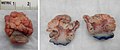 Gross pathology of a large squamous cell papilloma
 -
 Histopathology of a large squamous cell papilloma


