Volcanic ash: Difference between revisions
CSV import Tags: mobile edit mobile web edit |
CSV import |
||
| Line 30: | Line 30: | ||
{{Geology-stub}} | {{Geology-stub}} | ||
<gallery> | |||
File:Plume_from_eruption_of_Chaiten_volcano,_Chile.jpg|Volcanic ash | |||
File:Eyjafjallajokull-April-17.JPG|Volcanic ash | |||
File:DC-10-30_resting_on_its_tail_due_to_Pinatubo_ashfall.jpg|Volcanic ash | |||
File:MtCleveland_ISS013-E-24184.jpg|Volcanic ash | |||
File:Vulkaanilise_tuha_kiht.JPG|Volcanic ash | |||
File:Volcanic_Ash_from_Mount_St_Helens_-_GeoDIL_460.jpg|Volcanic ash | |||
File:Ashsem_small.jpg|Volcanic ash | |||
File:MtStHelensAsh1980eruption.jpg|Volcanic ash | |||
File:Volcanic_ash_grain_size_distributions.jpg|Volcanic ash | |||
File:MountRedoubtEruption.jpg|Volcanic ash | |||
File:Ash_Plume_and_Ash_Fall_of_May_1994_Eruption_of_Mount_Pagan_volcano_in_Northern_Mariana_Islands.jpg|Volcanic ash | |||
File:Cast_victim_eruptions_Pompeii.jpg|Volcanic ash | |||
</gallery> | |||
Revision as of 12:19, 18 February 2025
Volcanic ash refers to the fine particles of rock and volcanic glass created during volcanic eruptions. These particles are ejected into the atmosphere and can travel vast distances from the volcano. Volcanic ash poses significant hazards to health, aviation, and agriculture. It consists of tiny jagged pieces of rocks, minerals, and volcanic glass, the size of which is less than 2 millimeters in diameter.
Composition
Volcanic ash is primarily composed of silica (SiO2), with varying amounts of aluminum oxide (Al2O3), calcium oxide (CaO), magnesium oxide (MgO), and iron oxide (FeO, Fe2O3). The specific composition of volcanic ash can vary greatly depending on the type of volcano and the nature of the eruption. Ash particles are sharp and abrasive, leading to various impacts on the environment and human health.
Formation
The formation of volcanic ash occurs during explosive volcanic eruptions when the intense heat and pressure cause the magma to disintegrate into fine particles. These particles are then ejected into the atmosphere at high speeds. The size, shape, and composition of the ash particles can vary depending on the eruption's characteristics and the magma's composition.
Distribution
Volcanic ash can be dispersed over vast areas, depending on the size of the eruption and prevailing wind conditions. Ash clouds can travel thousands of kilometers from the eruption site, affecting regions far removed from the volcano. The distribution of ash is a critical factor in assessing the potential impacts on aviation, agriculture, and public health.
Hazards
Volcanic ash poses numerous hazards. For aviation, ash clouds can cause jet engine failure, abrasive damage to aircraft surfaces, and reduced visibility. For agriculture, ash fall can damage crops, contaminate water supplies, and reduce livestock productivity. For human health, inhaling fine ash particles can lead to respiratory problems, eye irritation, and skin irritation.
Mitigation
Mitigation strategies for volcanic ash include early warning systems, evacuation plans, and public education campaigns. For aviation, avoiding ash clouds is critical, necessitating close monitoring of volcanic eruptions and ash dispersion models. For agriculture and public health, protective measures such as wearing masks, covering water supplies, and cleaning ash from roofs can reduce the impacts.
See also
References
<references/>

-
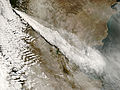 Volcanic ash
 -
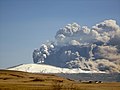 Volcanic ash
 -
 Volcanic ash
 -
 Volcanic ash
 -
 Volcanic ash
 -
 Volcanic ash
 -
 Volcanic ash
 -
 Volcanic ash
 -
Volcanic ash
-
 Volcanic ash
 -
 Volcanic ash
 -
 Volcanic ash


