Solid-state battery: Difference between revisions
CSV import |
CSV import |
||
| Line 36: | Line 36: | ||
{{Energy-stub}} | {{Energy-stub}} | ||
<gallery> | |||
File:Lithium dendrites.svg|Lithium dendrites | |||
File:Development of global scientific publications and patents families in solid-state batteries 2010-2023.jpg|Development of global scientific publications and patents families in solid-state batteries 2010-2023 | |||
</gallery> | |||
Latest revision as of 06:16, 3 March 2025
Solid-state battery technology represents a significant advancement in the field of energy storage systems, offering a promising alternative to conventional lithium-ion batteries. Unlike their liquid or gel-based counterparts, solid-state batteries utilize a solid electrolyte, which can lead to improvements in safety, energy density, and longevity.
Overview[edit]
Solid-state batteries are characterized by their use of a solid electrolyte material instead of the liquid or polymer gel electrolytes found in traditional lithium-ion batteries. This solid electrolyte can be made from various materials, including ceramics, solid polymers, or sulfides. The primary advantages of solid-state batteries include higher energy density, reduced risk of leakage and fire, and a wider operating temperature range.
Advantages[edit]
- Higher Energy Density: Solid-state batteries can store more energy than liquid-based batteries of the same size, making them ideal for use in electric vehicles and portable electronic devices.
- Improved Safety: The absence of flammable liquid electrolytes significantly reduces the risk of leaks and fires.
- Longer Lifespan: Solid electrolytes are less prone to degradation over time compared to their liquid counterparts, leading to batteries with a longer operational life.
- Wider Temperature Range: Solid-state batteries can operate more efficiently across a broader range of temperatures.
Challenges[edit]
Despite their advantages, solid-state batteries face several challenges that need to be addressed before they can be widely adopted:
- Manufacturing Costs: The production of solid-state batteries is currently more expensive than that of traditional lithium-ion batteries.
- Material Compatibility: Finding suitable solid electrolyte materials that are chemically stable and compatible with electrode materials is challenging.
- Energy Transfer Rates: Solid-state batteries often have lower ion conductivity compared to liquid-based batteries, which can affect charging times and power output.
Applications[edit]
Solid-state batteries have potential applications across various fields:
- Electric Vehicles: Their higher energy density and safety features make them particularly attractive for electric vehicle applications.
- Portable Electronics: The compact size and longevity of solid-state batteries could extend the battery life of smartphones, laptops, and wearable devices.
- Aerospace: The improved safety and energy density of solid-state batteries are beneficial for space missions and aviation.
Future Prospects[edit]
Research and development in solid-state battery technology are ongoing, with many companies and academic institutions working towards overcoming the current limitations. Advances in materials science and manufacturing techniques are expected to reduce costs and improve the performance of solid-state batteries, paving the way for their broader adoption in the coming years.
See Also[edit]

-
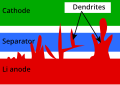 Lithium dendrites
 -
 Development of global scientific publications and patents families in solid-state batteries 2010-2023


