Introduction to genetics: Difference between revisions
CSV import Tags: mobile edit mobile web edit |
CSV import |
||
| Line 24: | Line 24: | ||
{{Genetics-stub}} | {{Genetics-stub}} | ||
== Introduction to genetics == | |||
<gallery> | |||
File:DNA_animation.gif|Animation of DNA structure | |||
File:Hair_colors_punnett.png|Punnett square showing hair color inheritance | |||
File:Redhead_close_up.jpg|Close-up of a redhead | |||
File:Genetic_code.svg|Diagram of the genetic code | |||
File:DNA_replication_split.svg|Illustration of DNA replication | |||
File:PCWmice1.jpg|Mice used in genetic research | |||
</gallery> | |||
Latest revision as of 05:04, 18 February 2025
Genetics is the branch of biology that concerns itself with genes, heredity, and variation in living organisms. It seeks to understand the process of trait inheritance from parents to offspring and the molecular structure and function of genes. The field of genetics plays a crucial role in understanding how genetic traits are passed on and how variation occurs among individuals within a population. This knowledge is fundamental to the study of diseases, evolutionary biology, and the development of new medical treatments.
History of Genetics[edit]
The history of genetics dates back to the 19th century with the work of Gregor Mendel, an Austrian monk, who is now considered the father of modern genetics. Mendel's experiments with pea plants laid the foundation for the laws of inheritance. He observed that certain traits are inherited following specific patterns. Mendel's work was not recognized until the turn of the 20th century, when the significance of his findings was understood, leading to the rapid development of the field.
Molecular Genetics[edit]
Molecular genetics is a sub-field of genetics that studies the structure and function of genes at a molecular level. This includes the analysis of DNA sequences, gene expression, and the regulation of genetic information. The discovery of the DNA double helix structure by James Watson and Francis Crick in 1953 marked a significant advancement in molecular genetics, providing a model for how genetic information is stored and transferred in living organisms.
Genetic Variation and Inheritance[edit]
Genetic variation is the difference in DNA sequences among individuals. These variations can affect how individuals respond to diseases, medications, and environmental factors. Inheritance patterns can be complex, with some traits being controlled by a single gene, while others are influenced by multiple genes and environmental factors. The basic patterns of inheritance include autosomal dominant, autosomal recessive, X-linked dominant, X-linked recessive, and mitochondrial inheritance.
Genomics[edit]
Genomics is an extension of genetics that involves the study of the entire genome of an organism. It includes the analysis of all of an organism's genes, their interactions, and their influence on the organism's growth, development, and health. The Human Genome Project, completed in 2003, was a landmark project in genomics that mapped and sequenced the entire human genome.
Applications of Genetics[edit]
The applications of genetics are vast and have significant implications in medicine, agriculture, and conservation. In medicine, genetic research has led to the development of genetic testing, gene therapy, and personalized medicine. In agriculture, genetics has been used to improve crop yields and resistance to pests and diseases. Conservation genetics focuses on the genetic management of endangered species and habitats.
Ethical, Legal, and Social Implications[edit]
The field of genetics also raises important ethical, legal, and social issues. These include concerns about genetic privacy, discrimination, and the ethical considerations of genetic modification and cloning. The debate over these issues is ongoing and involves scientists, ethicists, policymakers, and the public.

Introduction to genetics[edit]
-
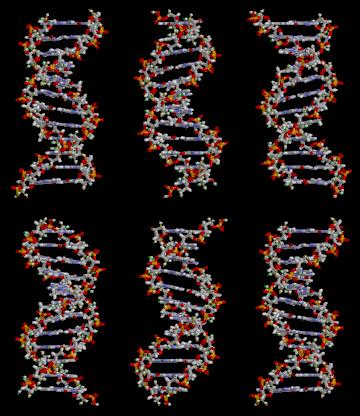 Animation of DNA structure
 -
 Punnett square showing hair color inheritance
 -
 Close-up of a redhead
 -
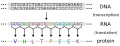 Diagram of the genetic code
 -
 Illustration of DNA replication
 -
 Mice used in genetic research


