Heat transfer: Difference between revisions
CSV import |
CSV import |
||
| Line 28: | Line 28: | ||
{{Physics-stub}} | {{Physics-stub}} | ||
== Heat_transfer == | |||
<gallery> | |||
File:Convection-snapshot.png|Convection snapshot | |||
File:Erbe.gif|Erbe | |||
File:Heat-transmittance-means2.jpg|Heat transmittance means | |||
File:Hot_metalwork.jpg|Hot metalwork | |||
File:Lightning_in_Arlington.jpg|Lightning in Arlington | |||
File:Kochendes_wasser02.jpg|Kochendes wasser | |||
File:Melting_icecubes.gif|Melting icecubes | |||
File:Nelson_tulsa_test.jpg|Nelson Tulsa test | |||
File:heat_engine.png|Heat engine | |||
File:Biochar.jpg|Biochar | |||
File:The_green_house_effect.svg|The green house effect | |||
File:Air_cooler.jpg|Air cooler | |||
</gallery> | |||
Latest revision as of 21:00, 23 February 2025
Heat transfer is the process by which thermal energy is exchanged between physical systems, depending on the temperature and properties of the materials involved. The fundamental modes of heat transfer are conduction, convection, and radiation. Understanding these mechanisms is essential in a wide range of disciplines, from engineering and environmental science to medicine and meteorology.
Conduction[edit]
Conduction is the transfer of heat through a solid material from a region of higher temperature to a region of lower temperature without any movement of the material as a whole. It occurs at the molecular level through the collision of particles and the movement of electrons within the body. The rate of heat transfer by conduction is governed by Fourier's law and is proportional to the temperature gradient and the cross-sectional area through which heat is conducted, and inversely proportional to the distance between the regions. Materials with high thermal conductivity, such as metals, are good conductors of heat, while those with low thermal conductivity, such as wood or foam, are considered insulators.
Convection[edit]
Convection is the transfer of heat by the physical movement of a fluid (liquid or gas) from one place to another. It can be natural, driven by buoyancy forces that result from temperature differences within the fluid, or forced, where the fluid is moved by external means such as a pump or fan. The rate of convective heat transfer is influenced by the fluid's velocity, its thermal properties, the surface area of the body being heated or cooled, and the temperature difference between the body and the fluid.
Radiation[edit]
Radiation is the transfer of heat in the form of electromagnetic waves, primarily in the infrared spectrum. Unlike conduction and convection, radiation does not require a medium and can occur in a vacuum. All bodies emit thermal radiation, and the amount of radiation emitted increases with the fourth power of the body's absolute temperature, as described by the Stefan-Boltzmann law. Factors that affect the rate of radiative heat transfer include the surface properties (emissivity and absorptivity) of the bodies involved and their relative positions and temperatures.
Applications and Implications[edit]
Heat transfer plays a crucial role in a myriad of applications. In engineering, it is fundamental to the design of heat exchangers, refrigeration and air conditioning systems, and thermal power plants. In environmental science, understanding heat transfer is essential for modeling climate change and the thermal behavior of natural systems. In medicine, heat transfer principles are applied in treatments such as hyperthermia therapy for cancer and in understanding the human body's response to extreme temperatures.
Mathematical Modeling[edit]
The mathematical modeling of heat transfer uses partial differential equations to describe the flow of heat in materials. Solutions to these equations can be complex and often require numerical methods for their solution, especially in systems with irregular geometries and varying boundary conditions.
See Also[edit]

Heat_transfer[edit]
-
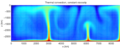 Convection snapshot
 -
 Erbe
Erbe -
 Heat transmittance means
 -
 Hot metalwork
 -
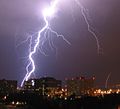 Lightning in Arlington
 -
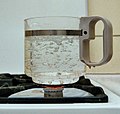 Kochendes wasser
 -
 Melting icecubes
 -
 Nelson Tulsa test
 -
 Heat engine
 -
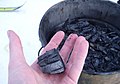 Biochar
 -
 The green house effect
 -
 Air cooler


