Environmental economics: Difference between revisions
CSV import Tags: mobile edit mobile web edit |
CSV import |
||
| Line 36: | Line 36: | ||
{{Economics-stub}} | {{Economics-stub}} | ||
<gallery> | |||
File:Growth,_Development_and_Environmental_Economics_in_Asia_(17241141112).jpg|Growth, Development and Environmental Economics in Asia | |||
File:Pollution_de_l'air.jpg|Air Pollution | |||
File:Nitrogen_Cycle.jpg|Nitrogen Cycle | |||
File:Water_cycle.png|Water Cycle | |||
File:Carbon_cycle-cute_diagram.svg|Carbon Cycle | |||
File:Oxygen_Cycle.jpg|Oxygen Cycle | |||
</gallery> | |||
Latest revision as of 11:18, 18 February 2025
Environmental economics is a sub-field of economics that considers the economic aspects of the environment and its natural resources. It studies how economic activities affect the environment and how they can be shaped to mitigate environmental problems. The field encompasses a broad range of topics, including sustainable development, resource management, environmental policy, and cost-benefit analysis of environmental goods and services.
Overview[edit]
Environmental economics is concerned with the efficient allocation of environmental resources to maximize social welfare. It involves the study of both renewable and non-renewable resources, pollution control, and the economic implications of environmental policies. The field applies theoretical and empirical techniques to analyze environmental issues and to suggest policy solutions that balance economic development with environmental sustainability.
Key Concepts[edit]
Externalities[edit]
An externality occurs when the production or consumption of goods and services imposes costs or benefits on third parties not involved in the transaction. Environmental externalities are common, such as pollution, where the polluter does not bear the full cost of the damage caused to the environment.
Public Goods[edit]
Environmental economics also deals with the concept of public goods. Public goods, such as clean air and water, are non-excludable and non-rivalrous, meaning that one person's consumption does not reduce the availability to others, and it is difficult to exclude non-payers from using the good.
Valuation[edit]
Valuing environmental goods and services is a critical aspect of environmental economics. This involves estimating the economic value of non-market goods, such as biodiversity or climate regulation. Techniques include contingent valuation, hedonic pricing, and travel cost method.
Environmental Policy Instruments[edit]
Environmental economics evaluates various policy instruments that can be used to address environmental problems, including:
- Market-based instruments: Such as emissions trading (cap and trade) and environmental taxes (Pigouvian taxes), which aim to correct market failures by internalizing externalities.
- Command and control: Regulations that set legal limits on the amount of pollution or require specific pollution control technologies.
- Subsidies and grants: Financial incentives to encourage environmentally friendly practices.
- Voluntary agreements: Between a government body and one or more private parties to achieve environmental objectives.
Challenges and Future Directions[edit]
Environmental economics faces several challenges, including dealing with global environmental issues like climate change, which require international cooperation. The valuation of environmental goods and services also presents difficulties due to their intangible nature and the long-term perspective often required. Future directions in the field may focus on integrating ecological and economic models more closely, improving valuation methods, and developing more effective policy instruments.
See Also[edit]

-
 Growth, Development and Environmental Economics in Asia
 -
 Air Pollution
 -
 Nitrogen Cycle
 -
 Water Cycle
 -
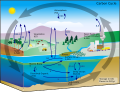 Carbon Cycle
 -
 Oxygen Cycle
.jpg)


