Seattle SuperSonics: Difference between revisions
CSV import |
CSV import |
||
| Line 29: | Line 29: | ||
[[Category:Sports in Seattle]] | [[Category:Sports in Seattle]] | ||
{{basketball-stub}} | {{basketball-stub}} | ||
== Seattle SuperSonics gallery == | |||
<gallery> | |||
File:Seattle SuperSonics logo.svg|Seattle SuperSonics logo | |||
File:Tom Meschery, Bob Rule and Wilt Chamberlain.jpeg|Tom Meschery, Bob Rule and Wilt Chamberlain | |||
File:Lenny Wilkens 1968.jpeg|Lenny Wilkens 1968 | |||
File:Jack Sikma 1978.jpg|Jack Sikma 1978 | |||
File:Kingdome usage, 1980 (32523178267).jpg|Kingdome usage 1980 | |||
File:George Karl.jpg|George Karl | |||
File:Lipofsky-Vin Baker.jpg|Vin Baker | |||
File:Kevin Durant Feb 2014.jpg|Kevin Durant Feb 2014 | |||
File:KeyArena (2890740573).jpg|KeyArena | |||
File:Squatch2005small.jpg|Squatch 2005 | |||
</gallery> | |||
Latest revision as of 05:53, 3 March 2025
Seattle SuperSonics, commonly referred to as the SuperSonics or simply the Sonics, was a professional basketball team based in Seattle, Washington, United States. The team was a member of the Pacific Division of the Western Conference in the National Basketball Association (NBA). The SuperSonics were established in 1967 as an expansion team but ceased operations in 2008 when the franchise relocated to Oklahoma City and became the Oklahoma City Thunder.
History[edit]
The Seattle SuperSonics were founded in 1967, entering the NBA as an expansion team along with the San Diego Rockets. The team's early years were marked by moderate success, reaching the playoffs for the first time in the 1974-1975 season. The pinnacle of the SuperSonics' history came in the 1978-1979 season when they won the NBA Championship, defeating the Washington Bullets in the Finals. This period was highlighted by the performances of key players such as Jack Sikma, Gus Williams, and Dennis Johnson.
Following their championship win, the SuperSonics remained competitive throughout the 1980s and early 1990s, making several playoff appearances. The team experienced a resurgence in the mid-1990s, led by stars Gary Payton and Shawn Kemp, reaching the NBA Finals again in 1996 but losing to the Chicago Bulls led by Michael Jordan.
In the early 2000s, the SuperSonics underwent several roster changes and struggled to achieve the same level of success. In 2006, the team was sold to an ownership group from Oklahoma City, leading to speculation about the team's relocation. Despite efforts by the city of Seattle to keep the team, the SuperSonics were officially relocated to Oklahoma City in 2008, marking the end of the franchise's 41-year presence in Seattle.
Relocation and Aftermath[edit]
The relocation of the SuperSonics to Oklahoma City was met with significant controversy and legal battles. The city of Seattle filed a lawsuit against the team's ownership to enforce the lease agreement at KeyArena, which was supposed to keep the team in Seattle until 2010. The lawsuit was settled in July 2008, allowing the team to move to Oklahoma City in exchange for a financial settlement.
The departure of the SuperSonics deeply affected the Seattle sports landscape and its fans. Efforts to bring an NBA team back to Seattle have been ongoing, including proposals for a new arena and attempts to purchase and relocate other NBA franchises to the city.
Legacy[edit]
The Seattle SuperSonics left a lasting legacy in the NBA and the city of Seattle. The team's 1979 championship remains a highlight in the city's sports history. Former players and coaches from the SuperSonics have continued to be involved in basketball and the NBA, contributing to the sport's growth and development.
Efforts to honor the SuperSonics' history include the preservation of team records and statistics by the Oklahoma City Thunder and the recognition of the SuperSonics' contributions to the NBA by fans and the league.
See Also[edit]
- List of NBA champions
- Oklahoma City Thunder
- History of the National Basketball Association
- Professional sports teams in Washington

Seattle SuperSonics gallery[edit]
-
Seattle SuperSonics logo
-
 Tom Meschery, Bob Rule and Wilt Chamberlain
 -
 Lenny Wilkens 1968
 -
 Jack Sikma 1978
 -
 Kingdome usage 1980
 -
 George Karl
 -
 Vin Baker
 -
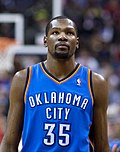 Kevin Durant Feb 2014
 -
 KeyArena
 -
 Squatch 2005


.jpg)


.jpg)


