Phyllotaxis: Difference between revisions
CSV import Tags: mobile edit mobile web edit |
CSV import |
||
| Line 27: | Line 27: | ||
[[Category:Botany]] | [[Category:Botany]] | ||
[[Category:Plant morphology]] | [[Category:Plant morphology]] | ||
<gallery> | |||
File:Aloe_polyphylla_1.jpg|Phyllotaxis | |||
File:opposite_leaves.png|Phyllotaxis | |||
File:whorled.png|Phyllotaxis | |||
File:alternate_leaves.png|Phyllotaxis | |||
File:Spiral_phyllotaxis.png|Phyllotaxis | |||
File:Veronicastrum_virg_album_C.jpg|Phyllotaxis | |||
File:Clivia-GreenPlants.ca.jpg|Phyllotaxis | |||
File:Lithops_2.jpg|Phyllotaxis | |||
File:Ulistnienie_(Phyllotaxys_opposite-decussate).png|Phyllotaxis | |||
File:Crassula_rupestris-PICT3087.jpg|Phyllotaxis | |||
File:phyllotaxis_golden_angle.svg|Phyllotaxis | |||
</gallery> | |||
Latest revision as of 12:00, 18 February 2025
Phyllotaxis refers to the arrangement of leaves on a plant stem. This pattern is crucial for maximizing exposure to sunlight and facilitating photosynthesis, while also minimizing shadow cast on other leaves. The study of phyllotaxis is a multidisciplinary field, intersecting botany, mathematics, and physics, offering insights into the growth patterns and evolutionary adaptations of plants.
Overview[edit]
The term "phyllotaxis" is derived from the Greek words phyllon, meaning leaf, and taxis, meaning arrangement. The arrangement of leaves, or nodes, on a plant stem can follow several patterns, the most common being spiral, opposite, and whorled arrangements. These patterns are determined by the angle between successive leaves, known as the divergence angle, which is often consistent within a species and can be related to the golden angle (approximately 137.5 degrees) for optimal packing efficiency.
Types of Phyllotaxis[edit]
Spiral Phyllotaxis[edit]
In spiral phyllotaxis, each leaf is positioned at a specific angle to the next, often related to the golden ratio, which optimizes light exposure and space usage. This pattern is visible in the arrangement of sunflower seeds, pine cones, and the leaves of many plants.
Opposite Phyllotaxis[edit]
Opposite phyllotaxis features pairs of leaves growing at the same level but on opposite sides of the stem. This arrangement is common in species such as mint (Mentha) and ash (Fraxinus).
Whorled Phyllotaxis[edit]
Whorled phyllotaxis involves three or more leaves growing at a single node in a symmetrical pattern around the stem. This can be seen in plants like lilies (Lilium) and some species of Euphorbia.
Mathematical Modeling[edit]
The Fibonacci sequence and the golden ratio play significant roles in the mathematical modeling of phyllotaxis. The Fibonacci sequence, a series of numbers where each number is the sum of the two preceding ones, often corresponds to the number of spirals observed in plants exhibiting spiral phyllotaxis. The golden ratio, approximately 1.618, is closely related to the Fibonacci sequence and is believed to govern the divergence angle between leaves in many plants.
Significance in Botany and Evolution[edit]
Phyllotaxis is not only aesthetically pleasing but also has evolutionary advantages. The specific arrangement of leaves can maximize light capture for photosynthesis, reduce wind resistance, and even influence reproductive strategies through the positioning of flowers and seeds. Understanding phyllotaxis can help elucidate plant evolutionary history and adaptive strategies.
Research and Applications[edit]
Research in phyllotaxis has applications in agriculture, horticulture, and even architecture and robotics. By understanding how plants optimize space and resources through leaf arrangement, scientists and engineers can develop more efficient crop planting patterns and bio-inspired designs for solar panels and robots.

-
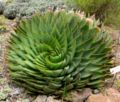 Phyllotaxis
 -
 Phyllotaxis
 -
 Phyllotaxis
 -
 Phyllotaxis
 -
Phyllotaxis
-
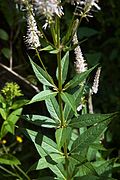 Phyllotaxis
 -
Phyllotaxis
-
 Phyllotaxis
 -
 Phyllotaxis
 -
 Phyllotaxis
 -
 Phyllotaxis


.png)


