Osazone: Difference between revisions
CSV import |
CSV import |
||
| Line 35: | Line 35: | ||
{{Chemistry-stub}} | {{Chemistry-stub}} | ||
<gallery> | |||
File:D-glucose-osazone-3D-balls.png|D-glucose osazone 3D model | |||
File:Osazone-Formation.png|Osazone formation process | |||
File:Osazone.svg|Osazone structure | |||
</gallery> | |||
Latest revision as of 01:38, 18 February 2025
Osazone formation is a chemical reaction that plays a significant role in the identification and differentiation of carbohydrates. This process involves the reaction of reducing sugars with phenylhydrazine, resulting in the formation of a crystalline derivative known as an osazone. The structure and melting point of osazones can be used to distinguish between different carbohydrates, making this reaction a valuable tool in biochemistry and analytical chemistry.
Overview[edit]
Reducing sugars, such as glucose, fructose, and maltose, can undergo a reaction with phenylhydrazine to form a compound known as an osazone. The reaction occurs in the presence of an acidic catalyst and involves the formation of a hydrazone at the carbonyl group of the sugar, followed by the substitution of two additional phenylhydrazine molecules at adjacent hydroxyl groups, leading to the formation of the osazone.
Reaction Mechanism[edit]
The osazone formation reaction begins with the conversion of the reducing sugar into its open-chain form, which contains an aldehyde or ketone group. Phenylhydrazine reacts with this carbonyl group to form a hydrazone. Subsequently, two more molecules of phenylhydrazine react with the first two hydroxyl groups adjacent to the carbonyl group, resulting in the elimination of two molecules of water and the formation of the osazone.
Significance[edit]
Osazone formation is particularly useful in the field of carbohydrate chemistry for several reasons:
- Identification of Reducing Sugars: It allows for the identification of reducing sugars, even in the presence of non-reducing sugars.
- Differentiation between Carbohydrates: Different carbohydrates form osazones with distinct crystal shapes and melting points, enabling their differentiation.
- Structural Analysis: The reaction provides insights into the configuration of the carbon atoms near the carbonyl group in the sugar molecule.
Experimental Procedure[edit]
The typical experimental procedure for osazone formation involves mixing a solution of the sugar with phenylhydrazine hydrochloride, sodium acetate, and acetic acid. The mixture is then heated in a water bath for a specific period, during which the osazone precipitates out of the solution. The precipitate is collected, washed, and recrystallized for further analysis, such as determining its melting point and examining its crystal structure under a microscope.
Applications[edit]
Osazone formation has applications in various fields, including:
- Biochemistry: In the study of carbohydrate metabolism and the identification of sugars in biological samples.
- Food Science: In the analysis of sugar content and composition in food products.
- Pharmaceuticals: In the quality control of carbohydrate-based drugs and excipients.
Limitations[edit]
While osazone formation is a valuable analytical tool, it has limitations, including:
- The reaction is specific to reducing sugars; non-reducing sugars do not form osazones.
- Some sugars may form osazones with very similar melting points, making differentiation challenging.
Conclusion[edit]
Osazone formation is a classic reaction in carbohydrate chemistry that remains relevant for the identification and differentiation of reducing sugars. Despite its limitations, the specificity and simplicity of the osazone formation reaction make it an indispensable tool in various scientific disciplines.

-
 D-glucose osazone 3D model
 -
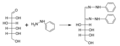 Osazone formation process
 -
 Osazone structure


