Nile monitor: Difference between revisions
CSV import Tags: mobile edit mobile web edit |
CSV import |
||
| Line 32: | Line 32: | ||
{{Reptile-stub}} | {{Reptile-stub}} | ||
<gallery> | |||
File:Nile_monitor_(Varanus_niloticus)_2.jpg|Nile monitor basking on a rock | |||
File:Nile_monitor_lizard_(Varanus_niloticus)_head.jpg|Close-up of a Nile monitor's head | |||
File:Nile_Monitor_(Varanus_niloticus)_juvenile_..._(51856177187).jpg|Juvenile Nile monitor | |||
File:Nile_Monitor_(Varanus_niloticus)_(52495033179).jpg|Nile monitor in its natural habitat | |||
File:Nile_monitor_Varanus_niloticus;_adult_dentition.jpg|Adult Nile monitor showing dentition | |||
File:Monitor_lizard_eating_crocodile_egg,_Katavi_National_Park.jpg|Monitor lizard eating a crocodile egg | |||
File:Nile_Monitor_(Varanus_niloticus)_(32201370332).jpg|Nile monitor climbing a tree | |||
File:Nile_Monitor,_Lake_Manyara.jpg|Nile monitor at Lake Manyara | |||
File:Varano_PDLL.jpg|Nile monitor | |||
</gallery> | |||
Latest revision as of 12:15, 18 February 2025
Nile Monitor (Varanus niloticus) is a large member of the monitor lizard family (Varanidae) that is native to Africa. This species is known for its adaptability to various environments and has been found in a wide range of habitats, including rivers, freshwater lakes, and along the Nile River, from which it derives its name. The Nile monitor is notable for its size, agility, and swimming ability, making it a formidable predator in its natural habitat.
Description[edit]
The Nile monitor is among the largest lizards in Africa, with adults commonly reaching lengths of up to 2 meters (6.6 feet), though larger specimens have been documented. They have muscular bodies, strong limbs, and powerful tails. Their skin is tough and adorned with distinctive patterns that serve as camouflage. The coloration of these lizards can vary but often includes shades of brown, green, or gray with yellowish or white markings.
Habitat and Distribution[edit]
Nile monitors are widely distributed across Sub-Saharan Africa and are found in a variety of aquatic and semi-aquatic environments. Their habitats range from arid areas to dense rainforests, but they are most commonly associated with freshwater bodies such as rivers, lakes, and swamps. The adaptability of the Nile monitor allows it to thrive in both natural and human-altered landscapes.
Behavior[edit]
Nile monitors are solitary and territorial animals. They are diurnal, spending most of their day actively hunting or basking in the sun. These lizards are excellent swimmers and climbers, skills that they use to hunt and to escape predators. Their diet is varied and includes fish, birds, insects, and small mammals. Nile monitors are also known to scavenge, which can bring them into conflict with humans when they feed on poultry or raid nests for eggs.
Reproduction[edit]
The reproductive behavior of the Nile monitor involves complex rituals including combat between males for access to females. Females lay their eggs in burrows or termite mounds, where the temperature and humidity are ideal for incubation. The number of eggs in a clutch can vary widely, but clutches of 20 to 60 eggs are not uncommon. The eggs hatch after a period of about 6 to 9 months, depending on environmental conditions.
Conservation Status[edit]
The Nile monitor is currently listed as Least Concern by the IUCN Red List, indicating that it is not at immediate risk of extinction. However, in some areas, populations are threatened by habitat destruction, pollution, and hunting. The species is also considered invasive in several regions outside its native range, where it can have negative impacts on local wildlife and ecosystems.
Invasive Species[edit]
Outside its native range, the Nile monitor has established populations in places like Florida, USA, where it is considered an invasive species. In these areas, Nile monitors can pose a threat to native wildlife through predation and competition for resources. Efforts to control and manage these populations are ongoing, but the adaptability and reproductive capacity of the Nile monitor make it a challenging species to manage.
See Also[edit]
References[edit]
<references/>
.png)
-
 Nile monitor basking on a rock
 -
 Close-up of a Nile monitor's head
 -
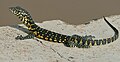 Juvenile Nile monitor
 -
 Nile monitor in its natural habitat
 -
 Adult Nile monitor showing dentition
 -
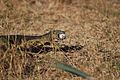 Monitor lizard eating a crocodile egg
 -
 Nile monitor climbing a tree
 -
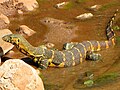 Nile monitor at Lake Manyara
 -
 Nile monitor
_2.jpg)
_head.jpg)
_juvenile_..._(51856177187).jpg)
_(52495033179).jpg)


_(32201370332).jpg)


