Rotational spectroscopy: Difference between revisions
CSV import |
CSV import |
||
| Line 33: | Line 33: | ||
{{Spectroscopy-stub}} | {{Spectroscopy-stub}} | ||
== Rotational spectroscopy gallery == | |||
<gallery> | |||
File:CF3I spectrum2.png|CF3I spectrum | |||
File:Rotational spectrum example.png|Rotational spectrum example | |||
File:Populations of rotational states.png|Populations of rotational states | |||
File:Atmospheric terahertz transmittance at Mauna Kea (simulated).svg|Atmospheric terahertz transmittance at Mauna Kea (simulated) | |||
</gallery> | |||
Latest revision as of 05:42, 3 March 2025
Rotational Spectroscopy is a branch of molecular spectroscopy concerned with the measurement of the frequencies of photons absorbed or emitted by molecules as they undergo transitions between rotational energy levels. This form of spectroscopy is a powerful tool for studying molecular structure, dynamics, and environment, providing insights into molecular geometry, bond lengths, and moments of inertia. It is widely used in physical chemistry, astrophysics, and atmospheric science to identify chemical compounds and determine their physical properties.
Fundamentals[edit]
Rotational spectroscopy is based on the quantum mechanical principle that molecules can rotate about their center of mass. The energy associated with these rotations is quantized, meaning that a molecule can only rotate with specific, discrete energy levels. The transition between these energy levels occurs when a molecule absorbs or emits electromagnetic radiation in the microwave or far-infrared region of the electromagnetic spectrum.
The energy difference between rotational levels is typically much smaller than that between vibrational and electronic energy levels, making rotational transitions observable at lower energies. The rotational energy levels of a molecule depend on its moment of inertia, which in turn depends on the mass distribution and geometry of the molecule. Thus, by analyzing the rotational spectra, one can infer the molecular structure and bond lengths.
Selection Rules[edit]
For a rotational transition to occur, there must be a change in the rotational quantum number, \(J\), of \(\Delta J = \pm 1\). Additionally, the molecule must have a permanent dipole moment; homonuclear diatomic molecules like \(N_2\) do not exhibit pure rotational spectra in the microwave region because they lack a permanent dipole moment.
Types of Rotational Spectroscopy[edit]
There are several types of rotational spectroscopy, each based on different principles and used for different applications:
- Microwave Spectroscopy: Involves the absorption of microwave radiation by molecules in the gas phase, leading to transitions between rotational energy levels.
- Fourier Transform Infrared (FTIR) Spectroscopy: Although primarily used for vibrational transitions, FTIR can also detect rotational transitions that occur simultaneously with vibrational transitions, providing rotational-vibrational spectra.
- Raman Spectroscopy: Can also be used to observe rotational transitions, especially for molecules that do not have a permanent dipole moment.
Applications[edit]
Rotational spectroscopy has a wide range of applications:
- Molecular Identification: The rotational spectrum of a molecule is unique, acting like a fingerprint for molecular identification.
- Structural Information: Provides information on molecular geometry, bond lengths, and angles.
- Isotopic Studies: Isotopic substitution affects the moment of inertia, and thus the rotational spectrum, allowing for the study of isotopic compositions.
- Astrophysics: Used to detect and identify molecules in interstellar space, contributing to our understanding of the chemical composition of the universe.
- Atmospheric Chemistry: Helps in the monitoring and study of atmospheric pollutants and greenhouse gases.
Limitations[edit]
While rotational spectroscopy is a powerful tool, it has limitations. It is primarily applicable to gas-phase samples, as interactions in liquids and solids broaden the spectral lines, making them difficult to resolve. Additionally, the requirement for a permanent dipole moment means that not all molecules can be studied using this technique.

This article is a spectroscopy-related stub. You can help WikiMD by expanding it!
Rotational spectroscopy gallery[edit]
-
 CF3I spectrum
 -
 Rotational spectrum example
 -
Populations of rotational states
-
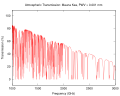 Atmospheric terahertz transmittance at Mauna Kea (simulated)


.svg)

