Opisthokont: Difference between revisions
CSV import Tags: mobile edit mobile web edit |
CSV import |
||
| Line 29: | Line 29: | ||
{{Eukaryote-stub}} | {{Eukaryote-stub}} | ||
<gallery caption="Opisthokont"> | |||
File:Opisthokonta collage.jpg|Opisthokonta collage | |||
File:Amoeba proteus with many pseudopodia.jpg|Amoeba proteus with many pseudopodia | |||
File:Mastigamoeba invertens.jpg|Mastigamoeba invertens | |||
File:Podomonas kaiyoae C.jpg|Podomonas kaiyoae | |||
File:Nuclearia sp Nikko (cropped).jpg|Nuclearia sp Nikko | |||
File:Linear arrangement of ascospores in the asci of the fungus Sordaria macrospora Cropped.jpg|Linear arrangement of ascospores in the asci of the fungus Sordaria macrospora | |||
File:Rozella allomycis2.jpg|Rozella allomycis | |||
File:Fibrillanosema spore.jpg|Fibrillanosema spore | |||
File:Sphaeroforma arctica.jpg|Sphaeroforma arctica | |||
File:Corallochytrium limacisporum.png|Corallochytrium limacisporum | |||
</gallery> | |||
Latest revision as of 06:20, 3 March 2025
Opisthokonts are a broad group of eukaryotes, including both the animal and fungus kingdoms, as well as various other groups of unicellular organisms. This classification is based on the direction of the flagellum in motile cells or gametes, where the single flagellum is posterior, pushing the cell forward. The name "Opisthokont" derives from the Greek words opistho (meaning "behind") and kontos (meaning "pole" or "flagellum"), reflecting this characteristic flagellar position.
Characteristics[edit]
Opisthokonts are distinguished by their mode of motility, with the flagellum located at the rear of the cell in those species that are motile. This is in contrast to other eukaryotic groups, where flagella, if present, are typically located at the front of the moving cell. In addition to this morphological characteristic, opisthokonts share several genetic and biochemical features, including similarities in mitochondrial DNA.
Classification[edit]
The opisthokonts are divided into two main clades: the Animalia (animals) and the Fungi, along with a diverse group of unicellular organisms. These include the Choanozoa, which are closely related to animals, and various groups of protists that are more closely related to fungi. The exact relationships and classifications within the opisthokonts are subjects of ongoing research and debate.
Animalia[edit]
The Animalia kingdom encompasses all multicellular animals, from simple sponges to complex mammals. Animals are characterized by their heterotrophic mode of nutrition, consuming organic material, and their ability to move at some stage of their life cycle.
Fungi[edit]
The Fungi kingdom includes yeasts, molds, and mushrooms. Fungi are essential decomposers in ecosystems, breaking down dead organic matter. They have a unique mode of nutrition, absorbing nutrients from their environment through their cell walls.
Choanozoa[edit]
Choanozoa, or choanoflagellates, are a group of free-living unicellular and colonial flagellate eukaryotes considered to be the closest living relatives of the animals. They play a crucial role in understanding the origin of multicellularity in the animal kingdom.
Evolution[edit]
The opisthokonts are thought to have diverged from other eukaryotic groups around 1 billion years ago, with the split between animals and fungi occurring shortly thereafter. The evolution of opisthokonts is a significant area of study, as it provides insights into the origins of multicellularity and the complex life cycles of animals and fungi.
Genomics[edit]
Recent advances in genomics have provided new insights into the diversity and evolutionary history of opisthokonts. Comparative genomics has revealed that despite their differences, animals and fungi share a core set of genes, supporting their close evolutionary relationship.
Ecological and Medical Importance[edit]
Opisthokonts play vital roles in ecosystems and have significant medical and economic impacts. Fungi are crucial in nutrient cycling and as sources of antibiotics, while animals, including humans, are central to many ecological processes. Understanding the biology and evolution of opisthokonts is essential for medical research, agriculture, and biodiversity conservation.

- Opisthokont
-
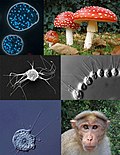 Opisthokonta collage
 -
 Amoeba proteus with many pseudopodia
 -
 Mastigamoeba invertens
 -
 Podomonas kaiyoae
 -
 Nuclearia sp Nikko
 -
 Linear arrangement of ascospores in the asci of the fungus Sordaria macrospora
 -
 Rozella allomycis
 -
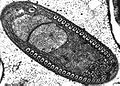 Fibrillanosema spore
 -
 Sphaeroforma arctica
 -
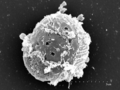 Corallochytrium limacisporum


.jpg)


