Pinus pinaster: Difference between revisions
CSV import Tags: mobile edit mobile web edit |
CSV import |
||
| Line 29: | Line 29: | ||
[[Category:Flora of Western Europe]] | [[Category:Flora of Western Europe]] | ||
{{Tree-stub}} | {{Tree-stub}} | ||
<gallery> | |||
File:Pinus_pinea_and_ruins_on_Palatine_Hill.jpg|Pinus pinea and ruins on Palatine Hill | |||
File:Pinus_pinaster02.jpg|Pinus pinaster | |||
File:Pinus_pinaster_decoration_cones.jpg|Pinus pinaster decoration cones | |||
File:Pinus_pinaster_Cones.jpg|Pinus pinaster cones | |||
File:Pinus_pinaster_JPG2.jpg|Pinus pinaster | |||
File:Pinheiro_bravo_Parque_Litoral.jpg|Pinus pinaster in Parque Litoral | |||
</gallery> | |||
Latest revision as of 10:58, 18 February 2025
Pinus pinaster, commonly known as the maritime pine or cluster pine, is a species of pine native to the Mediterranean region. It is a hardy, evergreen tree that has been widely cultivated for its timber, resin, and ornamental qualities. This article provides an overview of Pinus pinaster, including its taxonomy, description, distribution, ecology, uses, and conservation status.
Taxonomy[edit]
Pinus pinaster belongs to the genus Pinus, within the family Pinaceae. It was first described by Aiton in 1789. The species name pinaster is derived from Latin, meaning "pine-like".
Description[edit]
Pinus pinaster is a medium to large-sized tree, typically reaching heights of 20–35 meters, but can grow up to 50 meters under optimal conditions. The bark is thick and deeply fissured, with a reddish-brown color. The needles are stiff, dark green, and arranged in pairs, measuring 10–20 cm in length. The tree produces large, conical seed cones that are 10–20 cm long and 4–6 cm broad, maturing to a reddish-brown color. Each cone contains large, winged seeds which are dispersed by the wind.
Distribution and Habitat[edit]
The natural range of Pinus pinaster extends across the western Mediterranean region. It is found in Spain, Portugal, southern France, western Italy, and parts of North Africa. The species prefers sandy soils and is commonly found in coastal areas, thriving in both lowland and mountainous terrains up to 2000 meters in elevation. It is well adapted to fire-prone environments, which helps to maintain its dominance in certain ecosystems.
Ecology[edit]
Pinus pinaster plays a significant role in its ecosystem. It is a pioneer species, often one of the first to colonize disturbed or fire-damaged areas. The tree's thick bark provides protection against fires, allowing it to survive and regenerate quickly. Its seeds are an important food source for various bird and mammal species. Additionally, Pinus pinaster forms symbiotic relationships with mycorrhizal fungi, which enhance nutrient uptake from the soil.
Uses[edit]
Historically, Pinus pinaster has been valued for its timber, which is used in construction, furniture making, and shipbuilding due to its strength and durability. The tree is also tapped for resin, which is processed into turpentine and rosin, substances used in the chemical industry. In recent years, Pinus pinaster has gained popularity as an ornamental tree in parks and gardens. Its adaptability to different soil types and resistance to pests and diseases make it a favorable choice for landscaping.
Conservation Status[edit]
While Pinus pinaster is not currently listed as endangered, its populations are subject to threats from habitat loss, forest fires, and pest infestations. Conservation efforts are focused on sustainable management practices, including controlled burning to reduce fire risk and the promotion of biodiversity by maintaining a mix of tree species within forests.
See Also[edit]

-
 Pinus pinea and ruins on Palatine Hill
 -
 Pinus pinaster
 -
 Pinus pinaster decoration cones
 -
 Pinus pinaster cones
 -
 Pinus pinaster
 -
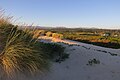 Pinus pinaster in Parque Litoral


