Newton's method: Difference between revisions
CSV import Tags: mobile edit mobile web edit |
CSV import Tag: Reverted |
||
| Line 36: | Line 36: | ||
[[Category:Mathematical analysis]] | [[Category:Mathematical analysis]] | ||
{{math-stub}} | {{math-stub}} | ||
<gallery> | |||
File:Methode_newton.png|Newton's method illustration | |||
File:newton_iteration.svg|Newton iteration steps | |||
File:NewtonIteration_Ani.gif|Newton's method animation | |||
File:NewtonsMethodConvergenceFailure.svg|Newton's method convergence failure | |||
File:newtroot_1_0_0_0_0_m1.png|Newton's method | |||
</gallery> | |||
Revision as of 05:04, 18 February 2025
Newton's Method, also known as the Newton-Raphson Method, is a powerful technique in numerical analysis for finding successively better approximations to the roots (or zeroes) of a real-valued function. The method is named after Isaac Newton and Joseph Raphson, who are credited with its development. It is widely used in scientific and engineering computations and is one of the most well-known algorithms for root finding.
Overview
Newton's Method starts with an initial guess for a root of the function and iteratively refines this guess by applying a specific formula. The method assumes that the function in question is differentiable, and it uses the derivative of the function at the approximation to inform the next guess. The basic idea is to approximate the function by a tangent line and then use the zero of this linear function as the next approximation to the root.
Formula
Given a function f and its derivative f' , the formula for Newton's Method is:
\[ x_{n+1} = x_n - \frac{f(x_n)}{f'(x_n)} \]
where:
- \(x_n\) is the current approximation,
- \(x_{n+1}\) is the next approximation,
- \(f(x_n)\) is the value of the function at \(x_n\), and
- \(f'(x_n)\) is the value of the derivative of the function at \(x_n\).
Convergence
The convergence of Newton's Method depends on several factors including the nature of the function and the initial guess. Under good conditions, the method converges very quickly, and the error decreases quadratically. However, there are situations where Newton's Method may fail to converge, or may converge to a root different from the intended one if the initial guess is not close enough to the actual root.
Applications
Newton's Method is used in a wide range of applications from optimization problems to solving equations in physics and engineering. It is particularly useful in scenarios where the function in question is complex and other methods of finding roots are inefficient or fail to converge.
Example
Consider the function \(f(x) = x^2 - 2\) which has roots at \(\sqrt{2}\) and \(-\sqrt{2}\). Using Newton's Method and an initial guess of 1, the sequence of approximations rapidly converges to \(\sqrt{2}\).
Limitations
While Newton's Method is powerful, it has limitations. It requires the calculation of the derivative of the function, which may not always be easy or possible. Additionally, the method can fail if the derivative is zero at the approximation, and it may not converge if the initial guess is not sufficiently close to the true root.
See Also

This article is a mathematics-related stub. You can help WikiMD by expanding it!
-
 Newton's method illustration
 -
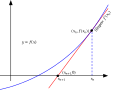 Newton iteration steps
 -
 Newton's method animation
 -
 Newton's method convergence failure
 -
 Newton's method


