Productive efficiency: Difference between revisions
CSV import |
CSV import |
||
| Line 29: | Line 29: | ||
{{Economics-stub}} | {{Economics-stub}} | ||
<gallery> | |||
File:Production_Possibilities_Frontier_Curve.svg|Production Possibilities Frontier Curve | |||
File:Productive_efficiency.svg|Productive Efficiency | |||
</gallery> | |||
Latest revision as of 02:05, 18 February 2025
Productive efficiency is a concept in economics that occurs when an economy or an economic system is operating in such a way that it cannot produce more of one good or service without decreasing the production of another good or service. This is achieved when production is carried out at the lowest possible cost and utilizes the least amount of resources to produce goods and services. Productive efficiency is closely related to the concept of technical efficiency, which focuses on producing goods and services using the least amount of inputs.
Overview[edit]
Productive efficiency is a key aspect of microeconomics and is fundamental to the study of market structures, including perfect competition, monopoly, monopolistic competition, and oligopoly. In a perfectly competitive market, productive efficiency is achieved because firms produce at the lowest point on their average total cost curve, where marginal cost equals average total cost. This ensures that resources are not wasted, and goods and services are produced in the most cost-effective manner.
Determinants[edit]
Several factors determine productive efficiency, including:
- Technology: Advances in technology can lead to more efficient production processes, reducing the amount of resources needed.
- Resource allocation: The way resources are allocated across different uses can impact the productive efficiency of an economy.
- Scale of production: Economies of scale can lead to lower average costs, contributing to productive efficiency.
- Workforce skills: A skilled workforce can increase the efficiency of production processes.
Implications[edit]
Productive efficiency has significant implications for both producers and consumers. For producers, achieving productive efficiency means that they can maximize their profits by minimizing costs. For consumers, it can lead to lower prices and a greater quantity of goods and services. However, it is important to note that productive efficiency does not necessarily imply allocative efficiency, which occurs when resources are distributed in a way that maximizes the welfare of consumers.
Challenges[edit]
Achieving productive efficiency can be challenging due to factors such as:
- Market failures: These can prevent markets from reaching productive efficiency by distorting prices and resource allocation.
- Government intervention: While sometimes necessary, government intervention in markets can sometimes lead to inefficiencies.
- Externalities: Positive or negative externalities can lead to overproduction or underproduction of certain goods and services, moving away from productive efficiency.
Conclusion[edit]
Productive efficiency is a crucial concept in economics that ensures resources are used in the most effective manner to produce goods and services. While achieving productive efficiency is the goal, various factors can hinder its realization. Understanding these challenges is essential for policymakers and businesses aiming to improve the efficiency of production and the overall economy.

-
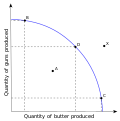 Production Possibilities Frontier Curve
 -
 Productive Efficiency


