Oxera: Difference between revisions
CSV import Tags: mobile edit mobile web edit |
CSV import |
||
| Line 25: | Line 25: | ||
[[Category:Flora of the Pacific]] | [[Category:Flora of the Pacific]] | ||
{{Botany-stub}} | {{Botany-stub}} | ||
== Oxera == | |||
<gallery> | |||
File:Oxera_puchella.jpg|Oxera puchella | |||
File:Status_iucn_EN_icon.svg|Endangered species icon | |||
File:Status_iucn_LC_icon.svg|Least Concern species icon | |||
File:Status_iucn_LC_icon.svg|Least Concern species icon | |||
File:Status_iucn_VU_icon.svg|Vulnerable species icon | |||
</gallery> | |||
Latest revision as of 04:48, 18 February 2025
Oxera is a genus of flowering plants belonging to the family Lamiaceae, commonly known as the mint or deadnettle family. This genus is not as widely recognized as some of its relatives within the Lamiaceae family, such as Mentha (mint) or Lavandula (lavender), but it plays a significant role in the ecosystems where it is found. The species within the Oxera genus are primarily native to the Pacific Islands, including areas such as New Caledonia and Vanuatu, where they contribute to the local biodiversity and have ecological and, in some cases, ethnobotanical significance.
Description[edit]
Oxera species are typically shrubs or small trees, characterized by their aromatic foliage, a common trait within the Lamiaceae family. The leaves are usually opposite, simple, and without stipules. The flowers of Oxera plants are notable for their bilateral symmetry, a characteristic feature of the Lamiaceae family. They are often brightly colored, attracting a variety of pollinators. The fruit of Oxera plants is a small nutlet, which is typical of the family.
Ecology[edit]
In their native habitats, Oxera species play a crucial role in supporting local wildlife, particularly pollinators such as bees, butterflies, and birds. The plants' flowers provide a source of nectar, while the dense foliage offers shelter and nesting sites. The ecological relationships between Oxera species and their pollinators are an area of ongoing research, highlighting the importance of these plants in maintaining biodiversity.
Ethnobotanical Uses[edit]
While the ethnobotanical uses of Oxera species are not as well documented as those of other Lamiaceae members, some species are used in traditional medicine and rituals in their native regions. These uses, however, vary widely between cultures and specific species, and more research is needed to fully understand the potential benefits and applications of Oxera plants.
Conservation[edit]
Several Oxera species are considered to be at risk due to habitat loss, invasive species, and climate change. Conservation efforts are crucial to protect these plants and their ecosystems. This includes habitat preservation, the control of invasive species, and research into the ecological roles and potential uses of Oxera species.
See Also[edit]
References[edit]
<references/>

Oxera[edit]
-
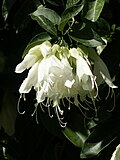 Oxera puchella
 -
 Endangered species icon
 -
 Least Concern species icon
 -
Least Concern species icon
-
 Vulnerable species icon


