Kamba people: Difference between revisions
CSV import Tags: mobile edit mobile web edit |
CSV import Tags: mobile edit mobile web edit |
||
| Line 28: | Line 28: | ||
[[Category:Bantu peoples]] | [[Category:Bantu peoples]] | ||
{{Ethnic group-stub}} | {{Ethnic group-stub}} | ||
<gallery> | |||
File:A_Kamba_Warrior.jpg|A Kamba Warrior | |||
File:NSRW_Africa_Mukamba.png|NSRW Africa Mukamba | |||
File:Weaving_of_baskets.jpg|Weaving of baskets | |||
File:Traditional_Kamba_Dancers.jpg|Traditional Kamba Dancers | |||
</gallery> | |||
Latest revision as of 04:58, 18 February 2025
Kamba people are an ethnic group predominantly found in the southeastern region of Kenya, particularly in an area commonly referred to as Ukambani which encompasses Machakos County, Kitui County, and Makueni County. The Kamba are part of the larger Bantu group and are closely related to other ethnic groups in the region. They are known for their skilled craftsmanship, vibrant culture, and significant contributions to the socio-economic development of Kenya.
History[edit]
The Kamba's origins can be traced back to the migration of Bantu-speaking peoples from Central Africa to the southeastern part of Kenya. Historical accounts suggest that the Kamba settled in their present location several centuries ago, following their migration through the eastern African region. They initially engaged in hunting and gathering before transitioning to agriculture and livestock rearing as their primary means of subsistence.
Culture[edit]
The culture of the Kamba people is rich and diverse, encompassing traditional music, dance, art, and religious beliefs. The Kamba are renowned for their wood carving skills, particularly the intricate designs of their drums, which are highly sought after both locally and internationally. Traditional dances and ceremonies play a significant role in the social and religious life of the community, marking important events such as births, marriages, and harvests.
Language[edit]
The Kamba speak Kikamba, a Bantu language that shares linguistic similarities with other languages spoken in the region. Kikamba is not only a means of communication but also an important vehicle for the transmission of cultural knowledge and traditions.
Religion[edit]
Traditionally, the Kamba practiced a form of animism, believing in the presence of spirits in natural objects and phenomena. However, with the arrival of Christian missionaries in the 19th century, Christianity has become the predominant religion among the Kamba, although traditional beliefs and practices still persist to some extent.
Economy[edit]
Historically, the Kamba were skilled hunters and gatherers, but over time, they shifted towards agriculture and livestock rearing as their main economic activities. Today, they are known for their agricultural produce, particularly fruits and vegetables, thanks to the fertile lands of the Ukambani region. Additionally, the Kamba engage in trade and craftsmanship, with wood carving and basketry being notable examples of their artisanal skills.
Social Structure[edit]
The social structure of the Kamba people is organized around the family unit, with extended families and clans playing a significant role in social organization. Age and gender are important determinants of social status within the community, with elders respected and consulted on important matters.
Contemporary Issues[edit]
Like many other ethnic groups, the Kamba face various challenges in the modern era, including economic disparities, environmental degradation, and cultural assimilation. Efforts are being made to address these issues through education, economic development initiatives, and the preservation of cultural heritage.
Notable Kamba[edit]
The Kamba people have produced notable figures in various fields, including politics, sports, and the arts. These individuals have contributed significantly to the development of Kenya and the promotion of Kamba culture on the national and international stages.
This article is a Ethnic group-related stub. You can help WikiMD by expanding it!
-
 A Kamba Warrior
 -
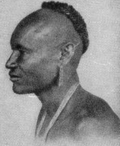 NSRW Africa Mukamba
 -
 Weaving of baskets
 -
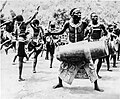 Traditional Kamba Dancers


