Gerardus Johannes Mulder: Difference between revisions
CSV import Tags: mobile edit mobile web edit |
CSV import |
||
| Line 27: | Line 27: | ||
{{Chemist-stub}} | {{Chemist-stub}} | ||
<gallery> | |||
File:Gerrit-Jan-Mulder-01.jpg|Gerrit Jan Mulder 01 | |||
File:Dr. G.J. Mulder.jpg|Dr. G.J. Mulder | |||
</gallery> | |||
Latest revision as of 05:28, 3 March 2025
Gerardus Johannes Mulder (27 December 1802 – 18 April 1880) was a Dutch chemist who is best known for his work in the early stages of protein research and for proposing the term "protein" itself. Mulder's contributions to chemistry, particularly in the analysis of proteins, have had a lasting impact on biochemistry and nutritional science.
Early Life and Education[edit]
Gerardus Johannes Mulder was born in Utrecht, Netherlands. He initially studied medicine at Utrecht University, where he developed a keen interest in chemistry. After receiving his medical degree, Mulder focused on chemical research, which led him to study under some of the most prominent chemists of his time.
Career[edit]
Mulder's early work involved the study of organic substances, including the chemical composition of plants. His research soon led him to investigate the composition of proteins, which were then known as "albuminous substances." Mulder was among the first to suggest that these substances were composed of carbon, hydrogen, nitrogen, and oxygen, laying the groundwork for the modern understanding of protein chemistry.
In the 1830s, Mulder collaborated with Jöns Jacob Berzelius, a renowned Swedish chemist. Berzelius was highly influential in Mulder's work, particularly in the study of organic compounds. It was during this period that Mulder proposed the term "protein," derived from the Greek word "proteios," meaning "primary" or "holding the first place," to emphasize the importance of these substances in living organisms.
Contributions to Chemistry[edit]
Mulder's most significant contribution to chemistry was his research on proteins. He conducted extensive analyses of various proteins, including those from animal and plant sources, and concluded that all proteins are composed of a common set of elements arranged in a similar manner. This hypothesis was a precursor to the modern understanding of proteins as polymers of amino acids.
In addition to his work on proteins, Mulder also made contributions to the study of other organic compounds and the development of analytical techniques in chemistry. His research on the chemical composition of wine and the distillation process contributed to the field of food chemistry.
Legacy[edit]
Gerardus Johannes Mulder's work laid the foundation for the field of protein chemistry and had a profound impact on the development of biochemistry and nutritional science. His proposal of the term "protein" has endured, and proteins are now recognized as essential components of all living organisms, crucial for their structure, function, and regulation.
Death[edit]
Gerardus Johannes Mulder passed away on 18 April 1880 in Bennekom, Netherlands. His contributions to chemistry, particularly in the understanding of proteins, have left a lasting legacy in the scientific community.
.jpg)
-
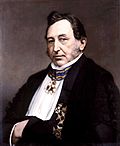 Gerrit Jan Mulder 01
 -
 Dr. G.J. Mulder


