Conoscopic interference pattern: Difference between revisions
CSV import Tags: mobile edit mobile web edit |
CSV import |
||
| Line 23: | Line 23: | ||
{{Crystallography-stub}} | {{Crystallography-stub}} | ||
{{Mineralogy-stub}} | {{Mineralogy-stub}} | ||
<gallery> | |||
File:Uniaxial_interference_figures.jpg|Uniaxial interference figures | |||
File:Biaxial_interference_figures.jpg|Biaxial interference figures | |||
</gallery> | |||
Latest revision as of 01:42, 18 February 2025
Conoscopic interference pattern refers to the optical phenomenon observed when a converging beam of light passes through an anisotropic material. This pattern is crucial in the study of the optical properties of crystals and other anisotropic substances. It is widely used in mineralogy, crystallography, and optical engineering to determine the internal structure and orientation of materials.
Overview[edit]
When a converging beam of light, such as that produced by a microscope equipped with a conoscopic lens, passes through an anisotropic material, it experiences double refraction or birefringence. This means the light is split into two rays, each traveling at different speeds and in different directions. Upon exiting the material, these rays interfere with each other, creating a pattern of light and dark areas known as a conoscopic interference pattern. The specific shape and orientation of this pattern provide valuable information about the optical properties of the material being examined.
Formation[edit]
The formation of a conoscopic interference pattern is governed by the principles of wave optics and crystal optics. When polarized light enters an anisotropic crystal, it is divided into two polarized rays, the ordinary ray (o-ray) and the extraordinary ray (e-ray), each vibrating in a plane perpendicular to the other. These rays take different paths through the crystal due to their different refractive indices. Upon exiting the crystal, the rays are brought to focus by a lens, where they overlap and interfere, forming the conoscopic interference pattern.
Types of Patterns[edit]
The appearance of the conoscopic interference pattern can vary significantly depending on the type of anisotropic material and its orientation with respect to the light source. Common patterns include isogyres, which are dark or light crosses that appear in the pattern, and isochromes, which are colored or black and white rings. The specific arrangement and appearance of these features can help identify the optical axis of the crystal and other optical properties.
Applications[edit]
Conoscopic interference patterns are used in various scientific and industrial fields. In mineralogy and crystallography, they help in identifying minerals and studying crystal structures. In optical engineering, conoscopic patterns are used to design and test optical devices like polarizers and wave plates. Additionally, this phenomenon is applied in the quality control of liquid crystal displays (LCDs) and other devices that utilize anisotropic materials.
Conclusion[edit]
The study of conoscopic interference patterns offers a powerful tool for analyzing the optical properties of anisotropic materials. By examining the specific features of these patterns, scientists and engineers can gain insights into the internal structure and orientation of crystals and other substances, facilitating advancements in various fields of research and industry.


This article is a crystallography-related stub. You can help WikiMD by expanding it!

This article is a mineralogy stub. You can help WikiMD by expanding it!
-
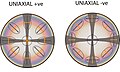 Uniaxial interference figures
 -
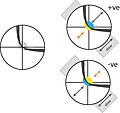 Biaxial interference figures


