Metal dithiolene complex: Difference between revisions
CSV import Tags: mobile edit mobile web edit |
CSV import |
||
| Line 22: | Line 22: | ||
[[Category:Organometallic chemistry]] | [[Category:Organometallic chemistry]] | ||
{{Chem-stub}} | {{Chem-stub}} | ||
== Metal_dithiolene_complex == | |||
<gallery> | |||
File:Mo(dith)3.png|Mo(dith)3 complex | |||
File:(Et4N)2Ni(mnt)2.jpg|(Et4N)2Ni(mnt)2 complex | |||
File:Resonance_structures_of_dithiolene_complex.png|Resonance structures of dithiolene complex | |||
File:Activesite.jpg|Active site of a dithiolene complex | |||
File:CAZYOR.png|Metal_dithiolene_complex | |||
</gallery> | |||
Latest revision as of 04:36, 18 February 2025
Metal dithiolene complexes are a class of coordination compounds consisting of a metal center coordinated to dithiolene ligands. Dithiolene ligands are organic compounds containing a sulfur atom bonded to a carbon atom, which is in turn bonded to another sulfur atom, forming a C2S2 ring. These complexes are notable for their diverse range of electronic structures, which can be tuned by varying the metal center or the substituents on the dithiolene ligand. This versatility makes metal dithiolene complexes interesting for applications in catalysis, molecular electronics, and as models for biological systems.
Structure and Bonding[edit]
Metal dithiolene complexes typically exhibit a square planar geometry around the metal center, which can be attributed to the strong σ-donation and π-backbonding between the metal and the dithiolene ligand. The dithiolene ligand acts as a 2-electron donor through its sulfur atoms, and the delocalized π-system over the C2S2 ring allows for efficient overlap with the metal d orbitals. This bonding interaction stabilizes low oxidation states of the metal, leading to complexes with unique electronic properties.
Synthesis[edit]
The synthesis of metal dithiolene complexes generally involves the reaction of a metal precursor with a dithiolene ligand precursor. A common method is the reaction of a metal salt with a dithione, which is then deprotonated to form the dithiolene ligand. Alternatively, preformed dithiolene ligands can be directly reacted with metal sources under appropriate conditions. The choice of solvent, temperature, and reaction time can significantly affect the yield and purity of the resulting complex.
Applications[edit]
Metal dithiolene complexes have found applications in various fields due to their unique properties. In catalysis, they are used as catalysts for reactions involving electron transfer, such as the reduction of carbon dioxide. In molecular electronics, their ability to undergo reversible redox reactions makes them suitable for use in molecular switches and transistors. Furthermore, the structural similarity of some metal dithiolene complexes to the active sites of certain enzymes has made them valuable models for studying enzyme mechanisms.
Biological Relevance[edit]
Certain metal dithiolene complexes are analogs of the active sites in enzymes such as xanthine oxidase and sulfite oxidase. These enzymes play crucial roles in the metabolism of nucleotides and sulfur-containing amino acids, respectively. Studying metal dithiolene complexes provides insights into the electronic structure and reactivity of these enzyme active sites, contributing to our understanding of their function in biological systems.
See Also[edit]

Metal_dithiolene_complex[edit]
-
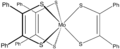 Mo(dith)3 complex
 -
 (Et4N)2Ni(mnt)2 complex
 -
 Resonance structures of dithiolene complex
 -
 Active site of a dithiolene complex
 -
 Metal_dithiolene_complex
3.png)
2Ni(mnt)2.jpg)


