Hemichordate: Difference between revisions
CSV import |
CSV import |
||
| Line 27: | Line 27: | ||
{{Deuterostome-stub}} | {{Deuterostome-stub}} | ||
<gallery> | |||
File:Enteropneusta USNM 1431735, MBIO32531, BMOO 08254 - Specimen Image.jpg|Enteropneusta USNM 1431735, MBIO32531, BMOO 08254 - Specimen Image | |||
File:Cephalodiscus nigrescens.jpg|Cephalodiscus nigrescens | |||
File:Journal.pbio.0040291.g001.svg|Journal pbio 0040291 g001 | |||
File:Hemichordate development.jpg|Hemichordate development | |||
File:DiplograptusCaneySprings.jpg|Diplograptus Caney Springs | |||
File:Branchiostoma lanceolatum (Pallas, 1774).jpg|Branchiostoma lanceolatum (Pallas, 1774) | |||
File:Tunicate komodo.jpg|Tunicate komodo | |||
File:Common carp (white background).jpg|Common carp (white background) | |||
File:Portugal 20140812-DSC01434 (21371237591).jpg|Portugal 20140812-DSC01434 (21371237591) | |||
File:Saccoglossus kowalevskii by Spengel 1893.png|Saccoglossus kowalevskii by Spengel 1893 | |||
</gallery> | |||
Latest revision as of 06:20, 3 March 2025
Hemichordata is a phylum of marine deuterostome animals, generally considered the sister group of the echinoderms. They are characterized by their unique body structure divided into three parts: the prosome, mesosome, and metasome, which correspond to the buccal tube, collar, and trunk in other terminologies. Members of this phylum are known as hemichordates. This article provides an overview of their classification, anatomy, ecology, and evolutionary significance.
Classification[edit]
Hemichordates are divided into two main classes: Enteropneusta, commonly known as acorn worms, and Pterobranchia, which includes smaller, colonial organisms. A third class, Planctosphaeroidea, is represented by a single species, Planctosphaera pelagica, known only from planktonic larvae. The phylogenetic relationship between these classes and their position within the deuterostomes has been a subject of ongoing research and debate.
Anatomy[edit]
The body of a hemichordate is divided into three distinct parts: the prosome or preoral lobe, the mesosome or collar, and the metasome or trunk. The prosome houses the mouth and buccal cavity, the mesosome contains the pharynx and gill slits, and the metasome encompasses the digestive tract and the heart-kidney complex. Hemichordates possess a simple nervous system and a unique structure called the stomochord, which was once thought to be homologous to the chordate notochord, but this view has been revised.
Ecology[edit]
Hemichordates are exclusively marine organisms. Acorn worms primarily inhabit benthic environments, burrowing in sediment or living in crevices, while pterobranchs are often found attached to substrates in deeper waters, forming colonies. They play a significant role in the marine ecosystem, contributing to the benthic community's nutrient cycling and serving as prey for a variety of marine predators.
Evolutionary Significance[edit]
Hemichordates are of particular interest to evolutionary biologists because they provide insights into the early evolution of deuterostomes and the origin of chordates. Their anatomical features, particularly the pharyngeal gill slits and the dorsal nerve cord, suggest a close relationship with both echinoderms and chordates. Molecular and morphological studies have supported the view that hemichordates and echinoderms form a clade, the Ambulacraria, which is a sister group to the chordates within the Deuterostomia.
Research and Conservation[edit]
Ongoing research on hemichordates focuses on their developmental biology, genomics, and ecological roles. Conservation efforts are generally directed towards their habitats, as hemichordates are sensitive to environmental changes, pollution, and habitat destruction.
See Also[edit]
This Deuterostome-related article is a stub.
-
 Enteropneusta USNM 1431735, MBIO32531, BMOO 08254 - Specimen Image
 -
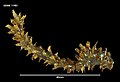 Cephalodiscus nigrescens
 -
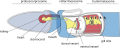 Journal pbio 0040291 g001
 -
 Hemichordate development
 -
 Diplograptus Caney Springs
 -
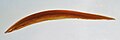 Branchiostoma lanceolatum (Pallas, 1774)
 -
 Tunicate komodo
 -
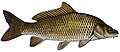 Common carp (white background)
 -
 Portugal 20140812-DSC01434 (21371237591)
 -
 Saccoglossus kowalevskii by Spengel 1893


.jpg)

.jpg)
.jpg)

