Janney coupler: Difference between revisions
CSV import Tags: mobile edit mobile web edit |
CSV import |
||
| Line 28: | Line 28: | ||
{{Transport-stub}} | {{Transport-stub}} | ||
<gallery> | |||
File:US_patent_594059_diagram.png|Janney coupler | |||
File:AM_174_Liège_Guillemins_cropped.jpg|Janney coupler | |||
File:Attelage_Henricot.jpg|Janney coupler | |||
File:NMBS_837.JPG|Janney coupler | |||
File:Janney_coupler_drawing.png|Janney coupler | |||
File:Syracuse-malleable_1899.jpg|Janney coupler | |||
File:Early_Janney-type_AAR_coupler.JPG|Janney coupler | |||
File:AAR_Type_F_coupler_d.jpg|Janney coupler | |||
File:Train_coupling.jpg|Janney coupler | |||
File:Tow_hitch_5.jpg|Janney coupler | |||
File:GNER-91116-coupling-01.jpg|Janney coupler | |||
File:SMS_301-coupler.jpg|Janney coupler | |||
</gallery> | |||
Latest revision as of 12:25, 18 February 2025
Janney coupler is a semi-automatic railway coupler designed and patented by Eli H. Janney in 1873 (U.S. Patent 138,405). The Janney coupler is used in the United States and elsewhere, but under different names, such as the AAR (Association of American Railroads) coupler or "knuckle" coupler due to its shape. The design has become the standard in North American freight railroads and is widely adopted due to its safety and efficiency improvements over earlier coupler systems.
History[edit]
The development of the Janney coupler was a significant advancement in railway safety. Before its invention, railroads used link-and-pin couplers, requiring manual coupling by workers, which was dangerous and resulted in numerous injuries and fatalities. Eli H. Janney, a former Confederate Army officer and dry goods clerk, sought to improve this system, leading to the creation of a coupler that could automatically engage without direct human intervention.
Design and Operation[edit]
The Janney coupler consists of two main components: the knuckle and the pocket. The knuckle pivots open to receive the adjoining car's coupler and closes to secure it. A locking pin then drops into place to ensure the couplers do not separate during operation. This design allows for cars to be coupled by gently pushing them together, significantly reducing the risk to railway workers.
The coupler operates on a standard size and shape, which allows for interoperability between different railroads' rolling stock. This standardization was a critical factor in the widespread adoption of the Janney coupler, facilitated by the Safety Appliance Act of 1893, which mandated the use of automatic couplers.
Impact[edit]
The introduction of the Janney coupler had a profound impact on rail safety and efficiency. It drastically reduced the number of accidents and fatalities associated with manual coupling and uncoupling of railcars. Furthermore, the Janney coupler's efficiency in coupling and uncoupling has facilitated the rapid handling of freight, contributing to the growth of railroads as a vital component of the American economy.
Modern Use and Variations[edit]
Today, the Janney coupler is the standard in North American railroads and has been adopted in various forms worldwide. There are several variations of the coupler designed for specific applications, including passenger service, where tighter lock and less slack are required. Despite its widespread use, ongoing improvements and modifications continue to be made to enhance its safety and operational efficiency.
See Also[edit]
References[edit]
<references/>

-
 Janney coupler
 -
 Janney coupler
 -
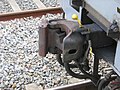 Janney coupler
 -
 Janney coupler
 -
 Janney coupler
 -
 Janney coupler
 -
Janney coupler
-
Janney coupler
-
Janney coupler
-
Janney coupler
-
Janney coupler
-
Janney coupler


