Flanking maneuver: Difference between revisions
CSV import Tags: mobile edit mobile web edit |
CSV import |
||
| Line 29: | Line 29: | ||
{{Military-stub}} | {{Military-stub}} | ||
<gallery> | |||
File:Battle_of_Marathon_Greek_Double_Envelopment.png|Battle of Marathon Greek Double Envelopment | |||
File:Battle_of_Agh-Darband_001.jpg|Battle of Agh-Darband | |||
File:Flanks_of_a_stationary_group.png|Flanking maneuver | |||
</gallery> | |||
Latest revision as of 04:08, 18 February 2025
Flanking maneuver is a tactical move in warfare where a combatant attempts to achieve an advantageous position over an opponent by moving along the opponent's side or rear. This maneuver is often used to surprise the enemy, attacking from a direction they do not expect and thereby gaining a tactical advantage. It is a fundamental tactic in both historical and modern military strategy, emphasizing the importance of positioning in combat.
Overview[edit]
The flanking maneuver involves moving forces to the enemy's side or rear to attack their flank, the part of their force to the side of their main front. This can force the opponent to fight on two fronts, divide their attention, and potentially cause confusion and disorder. The ultimate goal of a flanking maneuver is to encircle the enemy, cutting off their retreat and supply lines, leading to a situation where surrender or destruction becomes likely.
History[edit]
Historically, flanking maneuvers have been a decisive factor in many battles. For example, in the Battle of Cannae (216 BC), the Carthaginian general Hannibal effectively used a flanking maneuver to encircle and destroy a larger Roman army. Similarly, during the Battle of Gaugamela (331 BC), Alexander the Great used cavalry to perform a successful flanking attack against the Persian army, leading to a significant victory that contributed to the downfall of the Persian Empire.
Types of Flanking Maneuvers[edit]
There are several types of flanking maneuvers, each with its specific tactics and purposes:
- Single Envelopment: Attacking one flank of the enemy while holding or engaging the center and the other flank.
- Double Envelopment: Also known as a pincer movement, this involves attacking both flanks simultaneously, potentially leading to the encirclement of the enemy.
- Oblique Order: Involves strengthening one part of the line and advancing it to engage the enemy at an angle, aiming to roll up the enemy line from the flank.
- Turning Movement: Aims to capture strategic points behind the enemy, forcing them to retreat or reposition, thereby exposing their flanks.
Modern Usage[edit]
In modern warfare, the principles of flanking maneuvers remain relevant, although the methods and technologies have evolved. The use of aircraft, drones, and long-range missiles has expanded the possibilities for flanking attacks, allowing forces to strike from unexpected directions with speed and precision. However, the basic principle of achieving a positional advantage over the enemy remains unchanged.
Challenges and Countermeasures[edit]
Executing a successful flanking maneuver requires speed, secrecy, and coordination. The risk includes the possibility of being flanked in turn if the enemy anticipates the move. Modern armies often use reconnaissance, electronic warfare, and counter-mobility measures to detect and prevent flanking attacks.
See Also[edit]

-
 Battle of Marathon Greek Double Envelopment
 -
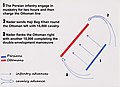 Battle of Agh-Darband
 -
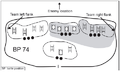 Flanking maneuver


