Japonic languages: Difference between revisions
CSV import Tags: mobile edit mobile web edit |
CSV import |
||
| Line 31: | Line 31: | ||
{{Linguistics-stub}} | {{Linguistics-stub}} | ||
== Japonic languages == | |||
<gallery> | |||
File:Ryukyu_Islands.svg|Map of the Ryukyu Islands | |||
File:History_of_Korea-476.PNG|Historical map of Korea in 476 | |||
</gallery> | |||
Latest revision as of 02:04, 17 February 2025
Japonic languages or Japanese-Ryukyuan languages are a language family primarily spoken in Japan and the Ryukyu Islands. They are divided into two main groups: the Japanese language, spoken in the main islands of Japan, and the Ryukyuan languages, spoken in the Ryukyu Islands. This language family is notable for its complex system of honorifics and its distinct phonetic and grammatical structures compared to other language families.
Classification[edit]
The Japonic languages are classified into two main branches:
- Japanese: The predominant language of Japan, with several dialects including Eastern Japanese, Western Japanese, and others.
- Ryukyuan: A group of languages spoken in the Ryukyu Islands, including Okinawan, Amami, Miyako, Yaeyama, and Yonaguni.
History[edit]
The origins of the Japonic languages are debated among linguists. Some theories suggest that they are related to other language families such as Altaic, Austronesian, or Koreanic, but these connections are not widely accepted due to lack of conclusive evidence. The Japonic languages are believed to have diverged from a common ancestor, with the Ryukyuan languages branching off from mainland Japanese several centuries ago.
Phonology[edit]
Japonic languages share several phonological features, such as a relatively small number of vowel sounds and a complex pitch accent system. Japanese and Ryukyuan languages differ in their treatment of certain phonemes, which can be attributed to historical sound changes.
Grammar[edit]
The grammar of Japonic languages is characterized by agglutination, where words are formed by stringing together morphemes without changing them as in fusional languages. They also feature a subject-object-verb (SOV) order, extensive use of honorifics, and a distinction between inclusive and exclusive "we" in some Ryukyuan languages.
Writing Systems[edit]
The Japanese writing system includes a combination of kanji (characters borrowed from Chinese), and two syllabaries: hiragana and katakana. Ryukyuan languages have historically been written using Japanese kanji and kana, but there is an increasing interest in developing independent writing systems for these languages.
Current Status[edit]
While Japanese is one of the world's major languages, the Ryukyuan languages are endangered, with declining numbers of speakers, especially among younger generations. Efforts are being made to preserve and revitalize these languages through education and cultural promotion.
See Also[edit]

This article is a linguistics stub. You can help WikiMD by expanding it!
Japonic languages[edit]
-
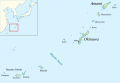 Map of the Ryukyu Islands
 -
 Historical map of Korea in 476


