Giant cowbird: Difference between revisions
CSV import |
CSV import Tags: mobile edit mobile web edit |
||
| Line 31: | Line 31: | ||
[[Category:Icteridae]] | [[Category:Icteridae]] | ||
{{Ornithology-stub}} | {{Ornithology-stub}} | ||
<gallery> | |||
File:Giant_cowbird_(Molothrus_oryzivorus_oryzivorus)_Las_Tangaras.jpg|Giant cowbird (Molothrus oryzivorus oryzivorus) at Las Tangaras | |||
</gallery> | |||
Latest revision as of 02:06, 17 February 2025
Giant Cowbird (Molothrus oryzivorus) is a species of bird in the family Icteridae, known for its brood parasitic behavior, similar to that of the common cuckoo. The species is native to Central and South America, ranging from southern Mexico to northern Argentina. This article provides an overview of the Giant Cowbird, including its taxonomy, physical description, behavior, habitat, and conservation status.
Taxonomy[edit]
The Giant Cowbird was first described by Linnaeus in 1758. It belongs to the order Passeriformes, family Icteridae, which includes various species of blackbirds, grackles, and orioles. The species has been the subject of taxonomic revisions, but currently, no subspecies are recognized.
Description[edit]
The Giant Cowbird is notable for its size, being the largest of the cowbirds. Males are significantly larger than females, with a body length ranging from 34 to 36 cm. They have a glossy black plumage and a long, decurved bill. Females are slightly smaller and less glossy. One of the most distinctive features of the Giant Cowbird is its vocalization, which includes a variety of whistles, clicks, and gurgles.
Behavior[edit]
Brood Parasitism[edit]
The Giant Cowbird exhibits brood parasitism, laying its eggs in the nests of other bird species, particularly oropendolas and caciques. Unlike some brood parasites, Giant Cowbird chicks do not eliminate host offspring but grow alongside them. This behavior has significant impacts on the breeding success of host species.
Feeding[edit]
Giant Cowbirds are omnivores, feeding on a diet that includes insects, seeds, and fruits. They are often seen foraging in mixed-species flocks, taking advantage of the disturbances caused by larger animals to catch prey.
Habitat[edit]
The species inhabits a variety of landscapes, including forests, savannas, and agricultural areas. They are particularly associated with areas near water, such as rivers and lakes. Despite their adaptability, habitat destruction poses a threat to some populations.
Conservation Status[edit]
The IUCN Red List currently lists the Giant Cowbird as Least Concern (LC). Although the species has a large range and a stable population size, habitat destruction and fragmentation could pose future threats. Conservation efforts are focused on habitat preservation and monitoring population trends.
See Also[edit]
References[edit]
<references/>

-
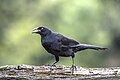 Giant cowbird (Molothrus oryzivorus oryzivorus) at Las Tangaras
_Las_Tangaras.jpg)
