Joseph Liouville: Difference between revisions
CSV import Tags: mobile edit mobile web edit |
CSV import |
||
| Line 36: | Line 36: | ||
{{mathematician-stub}} | {{mathematician-stub}} | ||
<gallery> | |||
File:Joseph_liouville.jpeg|Portrait of Joseph Liouville | |||
File:Journal_math_liouville.jpg|Cover of the Journal de Mathématiques Pures et Appliquées founded by Joseph Liouville | |||
File:Figaro_Liquid_Smoke_small.jpg|Figaro Liquid Smoke bottle | |||
</gallery> | |||
Latest revision as of 00:42, 18 February 2025
Joseph Liouville (24 March 1809 – 8 September 1882) was a renowned French mathematician who made significant contributions to various fields of mathematics, including number theory, differential geometry, and mathematical physics. He is best known for the discovery of Liouville's theorem in Hamiltonian mechanics, and for being the first to prove the existence of transcendental numbers.
Early Life and Education[edit]
Joseph Liouville was born in Saint-Omer, Pas-de-Calais, France. He showed an early interest in mathematics and was educated at the École Polytechnique, where he later became a professor. Liouville continued his studies and research at the École des Ponts et Chaussées, focusing on engineering and mathematics.
Career and Contributions[edit]
Liouville's career was marked by his work in several areas of mathematics. He contributed to the fields of differential equations, complex analysis, and celestial mechanics, among others. One of his most notable achievements was the introduction of Liouville's theorem in complex analysis, which states that any bounded entire function must be constant. This theorem has profound implications in the theory of functions of a complex variable.
In number theory, Liouville was the first to construct a transcendental number, showing that not all numbers are algebraic. This was a significant breakthrough at the time, as it expanded the understanding of the number system.
Liouville also made contributions to differential geometry, particularly in the study of Hamiltonian systems. His work in this area laid the groundwork for future developments in mathematical physics and the theory of dynamical systems.
Liouville's Journal[edit]
In addition to his mathematical research, Joseph Liouville founded and edited the Journal de Mathématiques Pures et Appliquées, often referred to as Liouville's Journal. This publication played a crucial role in the dissemination of mathematical knowledge in the 19th century and helped establish France as a center of mathematical research.
Legacy[edit]
Joseph Liouville's work has had a lasting impact on mathematics. His contributions to number theory, differential geometry, and mathematical physics continue to influence current research. The Liouville number, a concept in number theory, and Liouville's theorem in Hamiltonian mechanics, are named in his honor, reflecting his significant contributions to the field.
Selected Works[edit]
- Sur le développement des fonctions ou parties de fonctions en séries dont les divers termes sont assujettis à satisfaire à une même équation différentielle du second ordre contenant un paramètre variable (1837)
- Sur des classes très étendues de quantités dont la valeur n’est ni algébrique, ni même réductible à des irrationnelles algébriques (1844)
See Also[edit]
References[edit]
<references/>

-
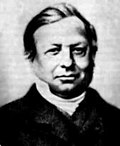 Portrait of Joseph Liouville
 -
 Cover of the Journal de Mathématiques Pures et Appliquées founded by Joseph Liouville
 -
Figaro Liquid Smoke bottle


