Mnemiopsis: Difference between revisions
CSV import |
CSV import |
||
| Line 21: | Line 21: | ||
{{Species-stub}} | {{Species-stub}} | ||
== Mnemiopsis gallery == | |||
<gallery> | |||
File:Sea walnut, Boston Aquarium (cropped).jpg|Sea walnut, Boston Aquarium | |||
File:Comb jelly.tif|Comb jelly | |||
File:Mnemiopsis.svg|Mnemiopsis | |||
File:Warty comb jelly (mnemiopsis) 2.jpg|Warty comb jelly (mnemiopsis) | |||
</gallery> | |||
Latest revision as of 06:15, 3 March 2025
Mnemiopsis leidyi, commonly known as the sea walnut or the comb jelly, is a species of tentaculate ctenophore (comb jelly), native to the western Atlantic coastal waters. Unlike most jellyfish, Mnemiopsis leidyi does not possess nematocysts (stinging cells) and is harmless to humans. This species has garnered attention due to its invasive nature, having spread to various marine environments outside its native range, where it significantly impacts local ecosystems and commercial fisheries.
Description[edit]
Mnemiopsis leidyi is characterized by its translucent, lobate body, which can grow up to 10 cm in length. The body is biradially symmetrical and possesses eight rows of cilia, known as comb rows, which it uses for locomotion. These comb rows refract light, producing a rainbow of colors that is visible in the dark waters of its natural habitat. The sea walnut has a simple digestive system, with a mouth, pharynx, and an anal pore, but lacks a centralized brain.
Habitat and Distribution[edit]
Originally from the temperate to subtropical waters of the western Atlantic, including the coasts of the United States and the Caribbean, Mnemiopsis leidyi has expanded its range dramatically. It has been found in the Black Sea, the Caspian Sea, the Baltic Sea, and more recently, the North Sea. This spread is largely attributed to ballast water discharge from ships. The species thrives in a variety of marine environments, from brackish to fully saline waters, and is known for its resilience to changes in temperature and salinity.
Ecological Impact[edit]
The introduction of Mnemiopsis leidyi into non-native waters has had significant ecological and economic impacts. In the Black Sea, for example, its proliferation led to a dramatic decline in zooplankton populations, which in turn caused a collapse in the fisheries for small, plankton-feeding fish. The species competes directly with native fish for food resources and has been linked to the decline of fish stocks in invaded areas. Efforts to control its population and mitigate its impact are ongoing, but have met with limited success.
Research and Management[edit]
Research on Mnemiopsis leidyi focuses on understanding its biology, ecology, and the mechanisms behind its rapid spread. Studies on its genetic diversity, reproductive habits, and tolerance to various environmental conditions are crucial for developing effective management strategies. Biological control methods, including the introduction of natural predators, are being explored, though with caution to avoid further ecological disruption.
Conclusion[edit]
Mnemiopsis leidyi serves as a stark reminder of the potential consequences of species introductions into non-native environments. Its story underscores the importance of monitoring and regulating ballast water discharge and other vectors of marine species dispersal. Continued research and international cooperation are essential to manage the impacts of this invasive species and protect marine biodiversity.
Mnemiopsis gallery[edit]
-
Sea walnut, Boston Aquarium
-
Comb jelly
-
Mnemiopsis
-
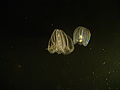 Warty comb jelly (mnemiopsis)
_2.jpg)

.jpg)
