Meloe: Difference between revisions
CSV import Tags: mobile edit mobile web edit |
CSV import |
||
| Line 23: | Line 23: | ||
{{Insect-stub}} | {{Insect-stub}} | ||
<gallery> | |||
File:Oil beetle from Wiener Prater.jpg|Oil beetle from Wiener Prater | |||
File:Oil beetle adult.jpg|Oil beetle adult | |||
</gallery> | |||
Latest revision as of 05:20, 3 March 2025
Meloe is a genus of insects belonging to the family Meloidae, commonly known as blister beetles. These beetles are known for their distinctive bodily fluids, which contain cantharidin, a potent chemical that can cause blistering on human skin. This characteristic is the origin of their common name. The genus Meloe is diverse, with species found in various habitats around the world, including grasslands, forests, and agricultural fields.
Description[edit]
Members of the genus Meloe exhibit a broad range of sizes and colors, but they are typically characterized by their soft-bodied appearance and elongated shape. Unlike many beetles, Meloe species have a somewhat flattened and soft exoskeleton. They can vary significantly in color, from black to metallic blue. The adults are flightless, lacking fully developed wings, which distinguishes them from many other beetles.
Life Cycle[edit]
The life cycle of Meloe beetles is complex and involves several stages, including egg, larva, pupa, and adult. The larvae are parasitic, initially targeting bees. The first-stage larvae, known as triungulins, are mobile and climb onto flowers where they attach themselves to foraging bees. They are then transported to the bee's nest, where they feed on bee larvae and the nest's provisions. This parasitic relationship can significantly impact bee populations, especially if Meloe populations are high.
Chemical Defense[edit]
One of the most notable aspects of Meloe beetles is their production of cantharidin, a toxic compound used as a defense mechanism against predators. Cantharidin can cause chemical burns and blistering on the skin and is toxic if ingested. Despite its toxicity, cantharidin has been used historically in traditional medicine and is still researched for potential medical applications.
Ecological Impact[edit]
While Meloe beetles play a role in controlling bee populations, their impact is generally not considered detrimental to healthy bee communities. However, in areas where Meloe populations become overly abundant, they can pose a threat to local bee species, particularly those that are already vulnerable or endangered.
Conservation[edit]
Conservation efforts for Meloe beetles are not typically a priority, as most species are not endangered. However, their role in the ecosystem, particularly their interactions with pollinator populations, underscores the importance of monitoring their numbers and understanding their ecological impact.
Research and Medical Interest[edit]
Research into the chemical properties of cantharidin and its potential medical applications continues. Its role in traditional medicine and potential use in modern pharmacology highlight the need for further study, particularly in the areas of cancer research and dermatological applications.

-
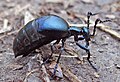 Oil beetle from Wiener Prater
 -
 Oil beetle adult


