Cochliomyia macellaria: Difference between revisions
CSV import Tags: mobile edit mobile web edit |
CSV import |
||
| Line 24: | Line 24: | ||
{{Insect-stub}} | {{Insect-stub}} | ||
<gallery> | |||
File:Cochliomyia_macellaria_P1200239a.jpg|Cochliomyia macellaria | |||
File:Cochliomyia_macellaria.tif|Cochliomyia macellaria | |||
File:Secondary_Screwworm_-_Cochliomyia_macellaria,_Meadowwood_Farm_SRMA,_Mason_Neck,_Virginia_-_8189649853.jpg|Secondary Screwworm - Cochliomyia macellaria, Meadowwood Farm SRMA, Mason Neck, Virginia | |||
File:Secondary_Screwworm_-_Cochliomyia_macellaria,_Julie_Metz_Wetlands,_Woodbridge,_Virginia.jpg|Secondary Screwworm - Cochliomyia macellaria, Julie Metz Wetlands, Woodbridge, Virginia | |||
File:Secondary_Screwworm_-_Cochliomyia_macellaria,_Meadowwood_Farm_SRMA,_Mason_Neck,_Virginia_-_8037965667.jpg|Secondary Screwworm - Cochliomyia macellaria, Meadowwood Farm SRMA, Mason Neck, Virginia | |||
</gallery> | |||
Latest revision as of 11:27, 18 February 2025
Cochliomyia macellaria, commonly known as the secondary screwworm or the American carrion fly, is a species of blow fly found in the Americas. It is of significant interest in forensic entomology and veterinary medicine due to its role in myiasis, the infestation of live vertebrate animals with dipterous larvae, which, at least in this species, feed on necrotic tissue.
Description[edit]
The adult Cochliomyia macellaria is metallic blue-green with black markings and has red eyes. It is approximately 10 to 14 mm in length. The larvae, or maggots, are creamy white in color and can reach up to 18 mm in length. They are characterized by their tapered shape and the presence of two dark, hook-like mouthparts.
Life Cycle[edit]
The life cycle of Cochliomyia macellaria is typical of blow flies and involves complete metamorphosis with four distinct stages: egg, larva, pupa, and adult. Females lay eggs on decaying organic matter, including carrion and wounds in living animals. The eggs hatch into larvae within 24 hours, and these larvae feed on the decomposing tissue. After several days of feeding, the larvae then pupate in the soil. The adult flies emerge from the pupae after 7 to 14 days, depending on environmental conditions.
Ecological Role[edit]
Cochliomyia macellaria plays a crucial role in the decomposition of dead animals and thus is an important species in nutrient cycling. However, its larvae can cause secondary myiasis in livestock, pets, and sometimes humans, leading to economic losses in agriculture and requiring medical attention.
Control and Prevention[edit]
Control measures for Cochliomyia macellaria include proper disposal of animal carcasses, use of insecticides, and management practices to reduce the chances of myiasis in livestock. Preventive measures such as regular inspection of animals for wounds and timely veterinary care can minimize the risk of infestation.
Forensic Entomology[edit]
In forensic entomology, Cochliomyia macellaria is used to estimate the post-mortem interval (PMI) of deceased individuals. The development stage of the larvae found on a corpse can give forensic scientists an indication of the time of death.
Research[edit]
Research on Cochliomyia macellaria focuses on its life cycle, behavior, and role in ecosystems, as well as its interaction with other species. Studies on the control of myiasis caused by this species are also significant for veterinary medicine and agriculture.

-
 Cochliomyia macellaria
 -
 Cochliomyia macellaria
 -
 Secondary Screwworm - Cochliomyia macellaria, Meadowwood Farm SRMA, Mason Neck, Virginia
 -
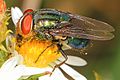 Secondary Screwworm - Cochliomyia macellaria, Julie Metz Wetlands, Woodbridge, Virginia
 -
 Secondary Screwworm - Cochliomyia macellaria, Meadowwood Farm SRMA, Mason Neck, Virginia


