Artishia Gilbert: Difference between revisions
CSV import |
CSV import |
||
| Line 1: | Line 1: | ||
== Arachnoid Mater == | |||
The '''arachnoid mater''' is one of the three meninges, the protective membranes that cover the [[central nervous system]] (CNS), which includes the [[brain]] and [[spinal cord]]. It is situated between the outermost layer, the [[dura mater]], and the innermost layer, the [[pia mater]]. The arachnoid mater is named for its spider web-like appearance, which is due to the delicate, fibrous tissue that composes it. | |||
=== Structure === | |||
The arachnoid mater is a thin, transparent membrane that loosely envelops the brain and spinal cord. It is composed of layers of connective tissue and is avascular, meaning it lacks blood vessels. The space between the arachnoid mater and the pia mater is known as the [[subarachnoid space]], which is filled with [[cerebrospinal fluid]] (CSF). This fluid acts as a cushion, providing a protective buffer for the CNS. | |||
The arachnoid mater is connected to the pia mater by fine, thread-like structures called arachnoid trabeculae. These trabeculae help maintain the subarachnoid space and allow for the circulation of CSF. | |||
=== Function === | |||
The primary function of the arachnoid mater is to protect the brain and spinal cord by acting as a barrier and a cushion. It helps to maintain the [[blood-brain barrier]] and plays a role in the circulation of cerebrospinal fluid. The arachnoid mater also serves as a conduit for blood vessels and nerves that supply the CNS. | |||
== | === Clinical Significance === | ||
The arachnoid mater can be involved in various medical conditions. One such condition is [[arachnoid cysts]], which are fluid-filled sacs that can form on the arachnoid membrane. These cysts can cause symptoms by compressing adjacent neural structures. | |||
[[ | Another condition is [[subarachnoid hemorrhage]], which occurs when there is bleeding into the subarachnoid space. This can be a life-threatening condition that requires immediate medical attention. | ||
[[Category: | |||
=== Development === | |||
During embryonic development, the meninges form from the mesoderm and ectoderm layers. The arachnoid mater, along with the pia mater, originates from the neural crest cells. As the CNS develops, the arachnoid mater differentiates and forms the characteristic web-like structure that defines it. | |||
== Related Pages == | |||
* [[Dura mater]] | |||
* [[Pia mater]] | |||
* [[Meninges]] | |||
* [[Cerebrospinal fluid]] | |||
== Gallery == | |||
<gallery> | |||
File:3D_Medical_Illustration_Meninges_Details.jpg|3D Medical Illustration of Meninges | |||
File:1316_Meningeal_LayersN.jpg|Meningeal Layers | |||
File:Meninges-en.svg|Diagram of Meninges | |||
File:Gray1196.png|Gray's Anatomy Illustration | |||
File:Brain_with_arachnoid_and_pia_mater.jpg|Brain with Arachnoid and Pia Mater | |||
File:Spinal_dura_mater_1.jpg|Spinal Dura Mater | |||
File:Gray767.png|Gray's Anatomy of Spinal Cord | |||
</gallery> | |||
[[Category:Anatomy of the central nervous system]] | |||
Revision as of 18:46, 11 February 2025
Arachnoid Mater
The arachnoid mater is one of the three meninges, the protective membranes that cover the central nervous system (CNS), which includes the brain and spinal cord. It is situated between the outermost layer, the dura mater, and the innermost layer, the pia mater. The arachnoid mater is named for its spider web-like appearance, which is due to the delicate, fibrous tissue that composes it.
Structure
The arachnoid mater is a thin, transparent membrane that loosely envelops the brain and spinal cord. It is composed of layers of connective tissue and is avascular, meaning it lacks blood vessels. The space between the arachnoid mater and the pia mater is known as the subarachnoid space, which is filled with cerebrospinal fluid (CSF). This fluid acts as a cushion, providing a protective buffer for the CNS.
The arachnoid mater is connected to the pia mater by fine, thread-like structures called arachnoid trabeculae. These trabeculae help maintain the subarachnoid space and allow for the circulation of CSF.
Function
The primary function of the arachnoid mater is to protect the brain and spinal cord by acting as a barrier and a cushion. It helps to maintain the blood-brain barrier and plays a role in the circulation of cerebrospinal fluid. The arachnoid mater also serves as a conduit for blood vessels and nerves that supply the CNS.
Clinical Significance
The arachnoid mater can be involved in various medical conditions. One such condition is arachnoid cysts, which are fluid-filled sacs that can form on the arachnoid membrane. These cysts can cause symptoms by compressing adjacent neural structures.
Another condition is subarachnoid hemorrhage, which occurs when there is bleeding into the subarachnoid space. This can be a life-threatening condition that requires immediate medical attention.
Development
During embryonic development, the meninges form from the mesoderm and ectoderm layers. The arachnoid mater, along with the pia mater, originates from the neural crest cells. As the CNS develops, the arachnoid mater differentiates and forms the characteristic web-like structure that defines it.
Related Pages
Gallery
-
 3D Medical Illustration of Meninges
 -
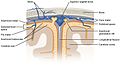 Meningeal Layers
 -
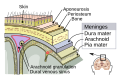 Diagram of Meninges
 -
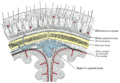 Gray's Anatomy Illustration
 -
 Brain with Arachnoid and Pia Mater
 -
 Spinal Dura Mater
 -
 Gray's Anatomy of Spinal Cord


