Buffon's needle problem: Difference between revisions
CSV import |
CSV import |
||
| Line 36: | Line 36: | ||
[[Category:Geometric probability]] | [[Category:Geometric probability]] | ||
{{math-stub}} | {{math-stub}} | ||
<gallery> | |||
File:Buffon_needle.svg|Diagram illustrating Buffon's needle problem | |||
File:Buffon's_needle_corrected.PNG|Corrected illustration of Buffon's needle problem | |||
File:Streicholz-Pi.jpg|Buffon's needle experiment with matches | |||
File:Buffon_needle_experiment_compressed.gif|Animated Buffon's needle experiment | |||
</gallery> | |||
Latest revision as of 04:22, 18 February 2025
Buffon's Needle Problem is a classic question in probability theory and geometric probability that was first posed by the French mathematician Georges-Louis Leclerc, Comte de Buffon in the 18th century. The problem involves dropping a needle of a certain length onto a plane containing parallel lines spaced equally apart, and determining the probability that the needle will cross one of the lines.
Statement of the Problem[edit]
Consider a floor made of parallel strips of wood, each of the same width, and a needle that is dropped onto the floor. The question that Buffon posed was: given the length of the needle and the width of the strips, what is the probability that the needle will lie across a line between two strips?
Mathematical Formulation[edit]
The solution to Buffon's Needle Problem involves calculus and trigonometry. Let the distance between two adjacent lines be \(d\), and the length of the needle be \(l\), where \(l \leq d\). The probability \(P\) that the needle will cross a line is given by the formula:
\[P = \frac{2l}{\pi d}\]
This formula assumes that the needle is dropped "randomly" in terms of position and orientation. The derivation of this formula involves integrating over all possible positions and orientations of the needle.
Historical Context[edit]
Buffon's Needle Problem is one of the earliest problems in the field of geometric probability, a branch of mathematics that deals with the probabilities of geometric figures and objects. It was introduced in Buffon's work "Essai d'Arithmétique Morale," and it is a part of a larger set of problems known as Buffon's problems.
Applications[edit]
Beyond its historical and theoretical interest, Buffon's Needle has applications in the modern world, particularly in the field of Monte Carlo methods. These are computational algorithms that rely on repeated random sampling to obtain numerical results. Buffon's Needle can be used as a simple Monte Carlo simulation to estimate the value of \(\pi\).
Simulation of Buffon's Needle[edit]
A simple computer simulation or physical experiment can be conducted to estimate \(\pi\) using Buffon's Needle. By dropping a needle many times and recording the number of times it crosses a line, one can use the formula to estimate \(\pi\) as follows:
\[\pi \approx \frac{2l \times \text{number of drops}}{d \times \text{number of crosses}}\]
See Also[edit]
External Links[edit]

This article is a mathematics-related stub. You can help WikiMD by expanding it!
-
 Diagram illustrating Buffon's needle problem
 -
 Corrected illustration of Buffon's needle problem
 -
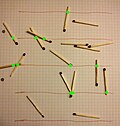 Buffon's needle experiment with matches
 -
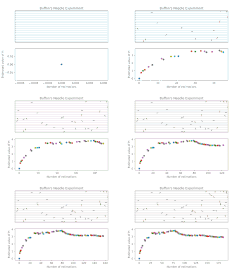 Animated Buffon's needle experiment


