First aid room: Difference between revisions
CSV import |
CSV import |
||
| Line 40: | Line 40: | ||
{{medicine-stub}} | {{medicine-stub}} | ||
<gallery> | |||
File:Bus,_tram_and_first_aid_signs,_Germany.jpg|Bus, tram, and first aid signs in Germany | |||
File:Women's_Factory_War_work_at_Slough_Training_Centre,_England,_UK,_1941_D3517.jpg|Women's Factory War work at Slough Training Centre, England, UK, 1941 | |||
File:Seattle_Hempfest_2007_-_017.jpg|Seattle Hempfest 2007 | |||
</gallery> | |||
Latest revision as of 04:18, 18 February 2025
First Aid Room
A first aid room is a designated area within a facility such as a school, workplace, public venue, or event space, where immediate care can be provided to individuals suffering from minor injuries or illnesses. This room is an essential component of an organization's health and safety infrastructure, ensuring that first aid can be administered in a timely and efficient manner before professional medical help is available.
Overview[edit]
The primary purpose of a first aid room is to offer a private and safe environment for the administration of first aid. It is typically equipped with essential medical supplies and equipment necessary for treating a wide range of minor medical emergencies. The room should be easily accessible, well-marked, and in compliance with local health and safety regulations.
Equipment and Supplies[edit]
A well-stocked first aid room includes a variety of equipment and supplies, such as:
- First aid kits with bandages, gauze, adhesive tape, scissors, tweezers, and antiseptic wipes
- Examination couch or bed
- Sink with running water
- Disposable gloves and protective eyewear
- Automated External Defibrillator (AED)
- Ice packs and heat packs
- Emergency contact information and medical forms
Staffing[edit]
Ideally, a first aid room is manned by personnel trained in first aid and CPR. These individuals are responsible for providing initial care and determining whether further medical attention is necessary. In larger organizations, a registered nurse or a paramedic may be available during operating hours.
Location and Accessibility[edit]
The location of the first aid room should be central to the areas of highest risk or population density, ensuring quick access in case of an emergency. It must be clearly signposted, with directions posted throughout the facility. Accessibility for individuals with disabilities is also a critical consideration.
Regulations and Best Practices[edit]
Regulations regarding first aid rooms vary by country and region, but common best practices include:
- Regular maintenance and restocking of first aid supplies
- Keeping the room clean, well-lit, and ventilated
- Confidentiality and privacy for individuals receiving care
- Record-keeping of all incidents and treatments provided
Training and Awareness[edit]
Organizations should provide regular first aid training for staff, ensuring that there are always qualified individuals available to respond to emergencies. Awareness campaigns can also help familiarize employees and visitors with the location and purpose of the first aid room.
Conclusion[edit]
A first aid room is a vital resource for providing immediate care during medical emergencies. By ensuring it is well-equipped, staffed by trained personnel, and accessible, organizations can significantly improve their emergency preparedness and response capabilities.

-
 Bus, tram, and first aid signs in Germany
 -
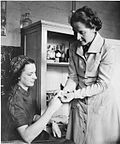 Women's Factory War work at Slough Training Centre, England, UK, 1941
 -
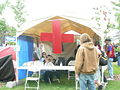 Seattle Hempfest 2007


