Artificial facet replacement: Difference between revisions
CSV import Tags: mobile edit mobile web edit |
CSV import |
||
| Line 1: | Line 1: | ||
== Aquilegia vulgaris == | |||
'''''Aquilegia vulgaris''''', commonly known as the European columbine, is a species of flowering plant in the [[Ranunculaceae]] family. It is native to Europe and is widely cultivated in gardens for its attractive flowers. | |||
== | === Description === | ||
''Aquilegia vulgaris'' is a herbaceous perennial plant that typically grows to a height of 60–90 cm. The plant has a basal rosette of leaves, with each leaf being divided into three leaflets. The flowers are nodding and bell-shaped, with five sepals and five petals. The petals are spurred, giving the flower its distinctive shape. The color of the flowers can vary, but they are often blue, purple, pink, or white. | |||
== | === Habitat === | ||
This species is found in a variety of habitats, including meadows, woodlands, and rocky areas. It prefers well-drained soil and can often be found in areas with partial shade. | |||
== | === Cultivation === | ||
''Aquilegia vulgaris'' is a popular garden plant due to its attractive flowers and ease of cultivation. It can be grown from seed or by division. The plant prefers a position in partial shade and well-drained soil. It is relatively low maintenance and can tolerate a range of soil types. | |||
=== Uses === | |||
In addition to its ornamental value, ''Aquilegia vulgaris'' has been used in traditional medicine. However, care should be taken as parts of the plant can be toxic if ingested. | |||
=== Varieties === | |||
There are several cultivated varieties of ''Aquilegia vulgaris'', including: | |||
* '''''Aquilegia vulgaris'' var. ''alba''''': Known for its white flowers. | |||
* '''''Aquilegia vulgaris'' var. ''nora barlow''''': Features double flowers with a mix of pink and green. | |||
== Related pages == | |||
* [[Ranunculaceae]] | |||
* [[Perennial plant]] | |||
* [[Herbaceous plant]] | |||
== Gallery == | |||
<gallery> | |||
File:Aquilegia vulgaris - Harilik kurekell.jpg|''Aquilegia vulgaris'' in bloom | |||
File:Aquilegia vulgaris MHNT.BOT.2009.13.42.jpg|Specimen of ''Aquilegia vulgaris'' | |||
File:Aquilegia nora barlow.JPG|''Aquilegia vulgaris'' var. ''nora barlow'' | |||
File:Aquilegia vulgaris 100503a.jpg|Close-up of ''Aquilegia vulgaris'' flowers | |||
File:Aquilegia vulgaris 100503c.jpg|''Aquilegia vulgaris'' in a garden setting | |||
</gallery> | |||
[[Category:Ranunculaceae]] | |||
[[Category:Flora of Europe]] | |||
[[Category:Garden plants]] | |||
Revision as of 18:57, 11 February 2025
Aquilegia vulgaris
Aquilegia vulgaris, commonly known as the European columbine, is a species of flowering plant in the Ranunculaceae family. It is native to Europe and is widely cultivated in gardens for its attractive flowers.
Description
Aquilegia vulgaris is a herbaceous perennial plant that typically grows to a height of 60–90 cm. The plant has a basal rosette of leaves, with each leaf being divided into three leaflets. The flowers are nodding and bell-shaped, with five sepals and five petals. The petals are spurred, giving the flower its distinctive shape. The color of the flowers can vary, but they are often blue, purple, pink, or white.
Habitat
This species is found in a variety of habitats, including meadows, woodlands, and rocky areas. It prefers well-drained soil and can often be found in areas with partial shade.
Cultivation
Aquilegia vulgaris is a popular garden plant due to its attractive flowers and ease of cultivation. It can be grown from seed or by division. The plant prefers a position in partial shade and well-drained soil. It is relatively low maintenance and can tolerate a range of soil types.
Uses
In addition to its ornamental value, Aquilegia vulgaris has been used in traditional medicine. However, care should be taken as parts of the plant can be toxic if ingested.
Varieties
There are several cultivated varieties of Aquilegia vulgaris, including:
- Aquilegia vulgaris var. alba: Known for its white flowers.
- Aquilegia vulgaris var. nora barlow: Features double flowers with a mix of pink and green.
Related pages
Gallery
-
 Aquilegia vulgaris in bloom
 -
 Specimen of Aquilegia vulgaris
 -
 Aquilegia vulgaris var. nora barlow
 -
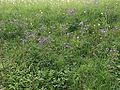 Close-up of Aquilegia vulgaris flowers
 -
 Aquilegia vulgaris in a garden setting


