Ocular tonometry: Difference between revisions
CSV import |
CSV import |
||
| Line 49: | Line 49: | ||
[[Category:Medical tests]] | [[Category:Medical tests]] | ||
[[Category:Eye procedures]] | [[Category:Eye procedures]] | ||
<gallery> | |||
File:Patient_and_tonometer.jpg|Patient and tonometer | |||
File:slit_lamp.jpg|Slit lamp | |||
File:Goldmann_mires.jpg|Goldmann mires | |||
File:PASCAL_tonometer.jpg|PASCAL tonometer | |||
File:Schiötz_Tonometer.jpg|Schiötz Tonometer | |||
File:TONOMETER_DIATON_2011.jpg|TONOMETER DIATON 2011 | |||
File:Tonometer.jpg|Tonometer | |||
File:Pascal_Tonometer.jpg|Pascal Tonometer | |||
File:PASCAL_SensorTip_on_eye.jpg|PASCAL Sensor Tip on eye | |||
</gallery> | |||
Latest revision as of 11:21, 18 February 2025
Ocular tonometry is a critical procedure in the field of ophthalmology that measures the intraocular pressure (IOP) within the eye. It is a fundamental diagnostic test used to assess the risk of glaucoma, a group of eye conditions that can cause blindness by damaging the optic nerve if left untreated. This article provides a comprehensive overview of ocular tonometry, including its importance, methods, and implications for eye health.
Overview[edit]
The eye is filled with fluids that maintain its shape and nourish its tissues. The balance between the production and drainage of these fluids determines the eye's intraocular pressure. Abnormal IOP readings can indicate various eye health issues, with glaucoma being the most significant. Ocular tonometry is the primary method for measuring IOP and is essential for diagnosing and managing this condition.
Types of Tonometry[edit]
Several techniques are available for measuring intraocular pressure, each with its advantages and limitations.
Applanation Tonometry[edit]
The most commonly used method is Goldmann applanation tonometry, which measures the force required to flatten a small, predefined area of the cornea. This technique is considered the gold standard for IOP measurement.
Non-contact Tonometry[edit]
Also known as air-puff tonometry, this method uses a rapid air pulse to flatten the cornea. Non-contact tonometry is quick and does not require direct contact with the eye, making it more comfortable for some patients.
Tono-Pen[edit]
The Tono-Pen is a handheld device that applies a gentle force to the cornea to measure IOP. Its portability makes it useful in various settings, including bedside examinations and screenings.
Dynamic Contour Tonometry[edit]
This newer method measures IOP by matching the contour of the cornea, potentially providing more accurate readings in eyes with abnormal corneal properties.
Indications for Tonometry[edit]
Ocular tonometry is indicated for:
- Screening for glaucoma, especially in individuals over the age of 40 or those with a family history of the condition. - Monitoring patients with a diagnosis of glaucoma or ocular hypertension. - Evaluating changes in vision or eye pain that may suggest an increase in IOP.
Procedure[edit]
The procedure for ocular tonometry varies slightly depending on the method used but generally involves the following steps:
1. Anesthetic eye drops are applied to numb the surface of the eye. 2. For methods requiring contact with the eye, a fluorescein dye may also be applied to help visualize the cornea. 3. The tonometer is then used to measure the IOP.
Patients typically experience minimal discomfort during the procedure.
Risks and Complications[edit]
Ocular tonometry is a safe procedure with a low risk of complications. However, minor side effects may include:
- Temporary blurring of vision due to the anesthetic drops or fluorescein dye. - Slight discomfort during the measurement.
In rare cases, there may be a risk of corneal abrasion or infection, particularly with contact methods.
Conclusion[edit]
Ocular tonometry is a vital diagnostic tool in the field of ophthalmology, enabling early detection and management of glaucoma and other conditions associated with abnormal intraocular pressure. With various techniques available, healthcare providers can select the most appropriate method based on the patient's specific needs and circumstances.
-
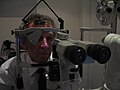 Patient and tonometer
 -
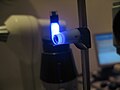 Slit lamp
 -
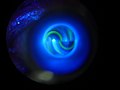 Goldmann mires
 -
 PASCAL tonometer
 -
 Schiötz Tonometer
 -
TONOMETER DIATON 2011
-
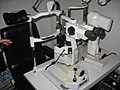 Tonometer
 -
 Pascal Tonometer
 -
 PASCAL Sensor Tip on eye


