Anterior accessory saphenous vein: Difference between revisions
CSV import Tags: mobile edit mobile web edit |
CSV import Tags: mobile edit mobile web edit |
||
| Line 25: | Line 25: | ||
{{Vein-stub}} | {{Vein-stub}} | ||
== Anterior_accessory_saphenous_vein == | |||
<gallery> | |||
File:Accessory_saphenous_vein2.png|Diagram showing the accessory saphenous vein | |||
File:Gray580.svg|Gray's Anatomy illustration of the veins of the leg | |||
File:Mickey_mouse_sign2.jpg|Ultrasound image showing the "Mickey Mouse" sign | |||
File:Varicose_ASV.jpg|Varicose anterior accessory saphenous vein | |||
File:Varicose_ASV1.jpg|Close-up of varicose anterior accessory saphenous vein | |||
File:Slide2por.JPG|Anterior accessory saphenous vein | |||
</gallery> | |||
Latest revision as of 04:38, 18 February 2025
Anterior Accessory Saphenous Vein
The anterior accessory saphenous vein (AASV) is a significant superficial vein located in the lower limb. It is a variant of the saphenous vein system, which plays a crucial role in the venous drainage of the leg. Understanding the anatomy, function, and clinical significance of the AASV is essential for healthcare professionals, especially those involved in the diagnosis and treatment of venous disorders.
Anatomy[edit]
The AASV originates from the dorsal venous network of the foot and ascends anteriorly along the leg. It runs parallel to the great saphenous vein (GSV), but is located more superficially. The course of the AASV can vary significantly among individuals. Typically, it drains into the GSV, but it can also drain into the femoral vein or other superficial veins.
Function[edit]
The primary function of the AASV, similar to other superficial veins, is to return deoxygenated blood from the lower extremity back to the heart. It contains valves that prevent the backflow of blood, ensuring unidirectional flow towards the heart. The AASV, along with other veins in the saphenous system, plays a vital role in the venous return from the leg, especially during physical activities.
Clinical Significance[edit]
The AASV is of particular interest in the context of varicose veins and venous insufficiency. Varicose veins occur when the valves in the vein become weak or damaged, causing blood to pool and the vein to enlarge. The AASV, due to its superficial location and variable anatomy, is often involved in varicose vein pathology.
Diagnosis[edit]
Diagnosis of AASV-related conditions typically involves a physical examination and imaging studies. Doppler ultrasound is a non-invasive imaging technique that is commonly used to assess the anatomy and function of the AASV, helping to identify any reflux or obstruction.
Treatment[edit]
Treatment options for AASV-related varicose veins include conservative management, such as compression stockings, and procedural interventions. Minimally invasive techniques, such as sclerotherapy, radiofrequency ablation, and endovenous laser therapy, have become the preferred methods for treating varicose veins involving the AASV. In some cases, surgical removal of the affected vein may be necessary.
Conclusion[edit]
The anterior accessory saphenous vein is an important component of the venous system of the lower limb. Its role in venous return and its involvement in common venous disorders make it a significant subject of study in vascular medicine. Advances in diagnostic and treatment modalities have improved the management of conditions involving the AASV, leading to better patient outcomes.
Anterior_accessory_saphenous_vein[edit]
-
 Diagram showing the accessory saphenous vein
 -
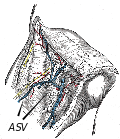 Gray's Anatomy illustration of the veins of the leg
 -
 Ultrasound image showing the "Mickey Mouse" sign
 -
 Varicose anterior accessory saphenous vein
 -
 Close-up of varicose anterior accessory saphenous vein
 -
 Anterior accessory saphenous vein


