Common cardinal veins: Difference between revisions
CSV import |
CSV import |
||
| Line 22: | Line 22: | ||
[[Category:Embryology]] | [[Category:Embryology]] | ||
{{medicine-stub}} | {{medicine-stub}} | ||
<gallery> | |||
File:Gray477.svg|Common cardinal veins | |||
File:Gray476.png|Common cardinal veins | |||
File:Gray54.png|Common cardinal veins | |||
File:Gray55.png|Common cardinal veins | |||
File:Gray464.png|Common cardinal veins | |||
</gallery> | |||
Latest revision as of 04:32, 18 February 2025
Common Cardinal Veins are crucial components of the embryonic circulatory system, playing a pivotal role in the development of the heart and major blood vessels. These veins are part of the venous system in the embryo, which eventually forms the major veins in the adult circulatory system.
Formation and Function[edit]
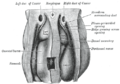
The common cardinal veins develop early in embryogenesis, arising from the merging of the anterior and posterior cardinal veins. The anterior cardinal veins drain blood from the head and neck region, while the posterior cardinal veins are responsible for draining the trunk and lower body. Together, they converge to form the left and right common cardinal veins, which then drain into the primitive heart.
During the course of development, the common cardinal veins undergo significant remodeling. The left common cardinal vein, along with parts of the anterior and posterior cardinal veins, contributes to the formation of the coronary sinus, a vital component of the heart's venous system. The right common cardinal vein, on the other hand, plays a role in forming the superior vena cava, a major vein that carries deoxygenated blood from the upper half of the body to the heart.
Clinical Significance[edit]
Abnormalities in the development of the common cardinal veins can lead to congenital heart defects, which are structural problems with the heart present from birth. These defects can affect the overall health and function of the heart and may require medical intervention, ranging from medication to surgery.
Evolutionary Perspective[edit]
The common cardinal veins are not unique to humans; they are found in various forms in other vertebrates, reflecting the evolutionary conservation of the cardiovascular system. Studying these veins in different species helps scientists understand the evolution and development of the circulatory system.
See Also[edit]

-
 Common cardinal veins
 -
 Common cardinal veins
 -
 Common cardinal veins
 -
 Common cardinal veins
 -
 Common cardinal veins


