Dipylidium caninum: Difference between revisions
CSV import |
CSV import |
||
| Line 18: | Line 18: | ||
{{medicine-stub}} | {{medicine-stub}} | ||
== Dipylidium_caninum == | |||
<gallery> | |||
File:Dipyl_can_worm1.JPG|Dipylidium caninum worm | |||
File:Dipylidium_LifeCycle.png|Dipylidium caninum life cycle | |||
File:Dipylidium_caninum_ovum_1.JPG|Dipylidium caninum ovum | |||
File:Dipylidium_caninum_proglottid_1.JPG|Dipylidium caninum proglottid | |||
File:dipylidium_caninum.jpg|Dipylidium caninum | |||
File:Dipylidium_caninum_worm.JPG|Dipylidium caninum worm | |||
</gallery> | |||
Latest revision as of 11:01, 18 February 2025
Dipylidium caninum, commonly known as the dog tapeworm, is a species of parasite that belongs to the class Cestoda in the phylum Platyhelminthes. This tapeworm primarily infects dogs and cats but can occasionally be found in humans, particularly in young children who accidentally ingest the parasite's intermediate host, the flea. The lifecycle of Dipylidium caninum involves two hosts: the primary host, usually a dog or cat, and the intermediate host, a flea.
Lifecycle[edit]
The lifecycle of Dipylidium caninum begins when the eggs are released into the environment through the feces of an infected animal. These eggs are then ingested by flea larvae that are present in the environment. Inside the flea larvae, the eggs develop into cysticercoids, an infective form of the tapeworm. When a dog or cat ingests an infected flea, typically during grooming, the cysticercoids develop into adult tapeworms in the intestines of the host. The adult tapeworms attach themselves to the intestinal wall using their scolex, which is equipped with hooks and suckers. As they mature, segments of the tapeworm, known as proglottids, are released into the host's feces, and the lifecycle begins anew.
Symptoms and Diagnosis[edit]
In dogs and cats, Dipylidium caninum infection may cause mild to moderate gastrointestinal symptoms, including diarrhea and vomiting. Infected animals may also show signs of irritation around the anus, leading to scooting behavior. In humans, infection is rare but can lead to similar gastrointestinal symptoms. Diagnosis of Dipylidium caninum infection is typically made by identifying the characteristic proglottids in the feces of the host or, less commonly, in the vomit. These proglottids are distinguishable by their cucumber seed appearance.
Treatment and Prevention[edit]
Treatment for Dipylidium caninum infection involves the administration of anthelmintic medications, which are effective in eliminating the tapeworms from the host's intestines. Commonly used medications include praziquantel and fenbendazole. Prevention of Dipylidium caninum infection is primarily focused on controlling flea populations, as fleas are the necessary intermediate host for the tapeworm's lifecycle. Regular use of flea control products on pets, as well as maintaining a clean environment, can significantly reduce the risk of infection.
Public Health Significance[edit]
While Dipylidium caninum is primarily a concern for pets, its potential to infect humans, particularly children, makes it a public health concern. Education on the importance of flea control in pets and the risks associated with accidental ingestion of fleas is crucial in preventing human cases of Dipylidium caninum infection.

Dipylidium_caninum[edit]
-
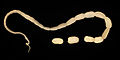 Dipylidium caninum worm
 -
 Dipylidium caninum life cycle
 -
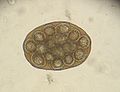 Dipylidium caninum ovum
 -
 Dipylidium caninum proglottid
 -
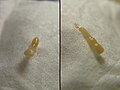 Dipylidium caninum
 -
 Dipylidium caninum worm


