Imhotep: Difference between revisions
CSV import |
CSV import |
||
| Line 23: | Line 23: | ||
{{Egypt-stub}} | {{Egypt-stub}} | ||
{{Biography-stub}} | {{Biography-stub}} | ||
<gallery> | |||
File:Imhotep,_donated_by_Padisu_MET_DP164134.jpg|Imhotep statue | |||
File:Sakkara,_la_pyramide_LCCN2017656975.jpg|Sakkara Pyramid | |||
File:Imhotep.svg|Imhotep | |||
File:An_invocation_to_I-em-hetep,_the_Egyptian_deity_of_medicine._Wellcome_V0018149.jpg|Invocation to Imhotep | |||
</gallery> | |||
Latest revision as of 04:23, 18 February 2025
Imhotep was an ancient Egyptian polymath who served under the Third Dynasty king Djoser as chancellor to the pharaoh and high priest of the sun god Ra at Heliopolis. He is considered by many to be the earliest known architect, engineer, and physician in history, though these claims are subject to debate. His contributions to medicine and architecture have left a lasting legacy, and he is often regarded as the real father of medicine.
Life and Career[edit]
Imhotep lived in Egypt around 2600 BC, serving under the rule of King Djoser. He held many titles, including that of chancellor, high priest, architect, and physician. His most notable achievement was the design and construction of the Step Pyramid at Saqqara, near Cairo. This was the first colossal stone building and the earliest colossal sculpture of Egypt, marking a significant advancement in architecture.
Contributions to Medicine[edit]
Imhotep is often credited as the founder of Egyptian medicine, and is said to have been the author of the Edwin Smith Papyrus, an Egyptian medical text, which contains almost 100 anatomical terms and describes 48 injuries and their treatment. However, the papyrus is named after the modern-day discoverer, Edwin Smith, not its original author. The papyrus is notable for being the world's oldest surviving surgical document.
Legacy[edit]
Imhotep's legacy is profound. He was deified by the Egyptians and worshipped as a god of medicine in both Egypt and Greece. He is recognized today as a pioneer in medicine, and his contributions to architecture, particularly the Step Pyramid, are celebrated.
See Also[edit]


-
 Imhotep statue
 -
 Sakkara Pyramid
 -
 Imhotep
 -
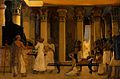 Invocation to Imhotep


