Mental nerve: Difference between revisions
CSV import |
CSV import |
||
| Line 30: | Line 30: | ||
{{anatomy-stub}} | {{anatomy-stub}} | ||
<gallery> | |||
File:Gray778.png|Gray778 | |||
File:Gray784.png|Gray784 | |||
</gallery> | |||
Latest revision as of 06:11, 3 March 2025
Mental nerve
The Mental nerve is a sensory nerve that provides sensation to the lower lip, chin, and the skin and mucous membranes of the lower jaw. It is a branch of the inferior alveolar nerve, which is itself a branch of the mandibular nerve, the third division of the trigeminal nerve.
Anatomy[edit]
The mental nerve exits the mandible via the mental foramen, which is located near the roots of the second lower premolar tooth. After exiting the foramen, the nerve divides into three branches: one descends to the skin of the chin, and the other two ascend to the skin and mucous membrane of the lower lip.
Function[edit]
The mental nerve carries sensory information from the mucous membranes of the lower lip, the skin of the chin and lower jaw, and the labial gingiva of the anterior teeth back to the brain. This information is processed in the brain to allow for sensations such as touch, temperature, and pain.
Clinical significance[edit]
Damage to the mental nerve can result in numbness or paresthesia in its distribution area. This can occur due to trauma, surgery, or infection in the area. In dentistry, the mental nerve is often anesthetized using a mental nerve block to prevent pain during procedures involving the lower lip or teeth.
See also[edit]
References[edit]

-
 Gray778
 -
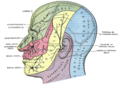 Gray784


