Intranasal drug delivery: Difference between revisions
CSV import Tags: mobile edit mobile web edit |
CSV import |
||
| Line 29: | Line 29: | ||
{{pharmacology-stub}} | {{pharmacology-stub}} | ||
<gallery> | |||
File:Nose-to-Brain_Drug_Pathway.png|Nose-to-Brain Drug Pathway | |||
File:Olfactory_region.png|Olfactory Region | |||
File:Protective_barriers_of_the_brain.jpg|Protective Barriers of the Brain | |||
File:Liposome.jpg|Liposome | |||
File:Nanosphere.png|Nanosphere | |||
File:Nanocapsule.png|Nanocapsule | |||
File:Exosome_formation.png|Exosome Formation | |||
File:Dendrimer_and_dendron.jpg|Dendrimer and Dendron | |||
</gallery> | |||
Revision as of 11:19, 18 February 2025
Intranasal drug delivery refers to the administration of drugs through the nasal route. This method of drug delivery has been utilized for several decades due to its numerous advantages, including rapid absorption, avoidance of first-pass metabolism, and improved patient compliance.
Overview
Intranasal drug delivery is a non-invasive method of administering drugs, which involves the introduction of pharmaceutical compounds into the nasal cavity. This method is particularly advantageous for drugs that are poorly absorbed through the gastrointestinal tract or are subject to significant first-pass metabolism.
Mechanism of Action
The mechanism of action of intranasal drug delivery involves the absorption of the drug through the nasal mucosa. The nasal cavity is highly vascularized, allowing for rapid absorption of drugs into the systemic circulation. The drug can then be distributed throughout the body to exert its therapeutic effect.
Advantages
There are several advantages to intranasal drug delivery. These include:
- Rapid absorption: Due to the high vascularity of the nasal cavity, drugs administered intranasally are rapidly absorbed into the systemic circulation.
- Avoidance of first-pass metabolism: Drugs administered intranasally bypass the gastrointestinal tract and liver, avoiding first-pass metabolism and increasing bioavailability.
- Improved patient compliance: Intranasal drug delivery is non-invasive and painless, leading to improved patient compliance.
Disadvantages
Despite its advantages, intranasal drug delivery also has some disadvantages. These include:
- Limited drug load: The volume of the nasal cavity is limited, restricting the amount of drug that can be administered.
- Nasal irritation: Some drugs can cause irritation to the nasal mucosa, leading to discomfort or adverse reactions.
Applications
Intranasal drug delivery has been used for a variety of drugs, including analgesics, vaccines, and hormones. It is also being explored for the delivery of neurotherapeutics and gene therapy.
Future Directions
Research is ongoing to improve the efficiency and effectiveness of intranasal drug delivery. This includes the development of new drug formulations and delivery devices, as well as the exploration of novel applications.

-
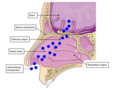 Nose-to-Brain Drug Pathway
 -
 Olfactory Region
 -
 Protective Barriers of the Brain
 -
 Liposome
 -
 Nanosphere
 -
 Nanocapsule
 -
Exosome Formation
-
Dendrimer and Dendron


