RAPTA: Difference between revisions
CSV import |
CSV import |
||
| Line 34: | Line 34: | ||
{{pharmacology-stub}} | {{pharmacology-stub}} | ||
== RAPTA == | |||
<gallery> | |||
File:RAPTA-T.tif|RAPTA | |||
File:RAPTA C.tif|RAPTA | |||
</gallery> | |||
Latest revision as of 01:49, 20 February 2025
RAPTA (Ruthenium-based Anticancer Pharmaceuticals that are Activatable) is a class of anticancer drugs that are based on ruthenium complexes. These drugs are designed to be activated in the hypoxic conditions that are often found in solid tumors.
History[edit]
RAPTA drugs were first developed in the early 2000s by a team of researchers at the University of Zurich. The team was led by Paul J. Dyson, who had previously worked on the development of other ruthenium-based anticancer drugs.
Mechanism of Action[edit]
RAPTA drugs work by binding to DNA and disrupting its function, thereby preventing the replication of cancer cells. The drugs are designed to be activated in hypoxic conditions, which are often found in solid tumors. This means that they are relatively inactive in healthy tissues, which reduces the risk of side effects.
Clinical Trials[edit]
Several RAPTA drugs have been tested in clinical trials. These trials have shown that the drugs are effective against a range of cancers, including breast cancer, lung cancer, and colorectal cancer. However, further research is needed to determine the optimal dosing and administration strategies for these drugs.
Future Directions[edit]
Research is currently underway to develop new RAPTA drugs with improved efficacy and reduced side effects. These drugs are being designed to target specific types of cancer cells, which could potentially increase their effectiveness and reduce the risk of side effects.
See Also[edit]
References[edit]
<references />

RAPTA[edit]
-
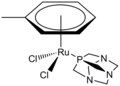 RAPTA
RAPTA -
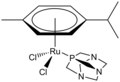 RAPTA
RAPTA
