Behavioural despair test: Difference between revisions
CSV import |
CSV import |
||
| Line 26: | Line 26: | ||
[[Category:Depression]] | [[Category:Depression]] | ||
{{pharmacology-stub}} | {{pharmacology-stub}} | ||
==Behavioural_despair_test== | |||
<gallery> | |||
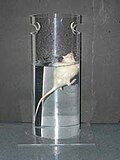
File:Forced-swimming_test.jpg|Forced-swimming test | |||
</gallery> | |||
Latest revision as of 00:00, 25 February 2025
Behavioural Despair Test is a widely used experimental method in Behavioural Neuroscience and Psychopharmacology to evaluate Antidepressant drugs or to induce a depressive-like state in animals, typically rodents. The test is based on the observation that a rodent placed in a container filled with water will initially attempt to escape, but will eventually exhibit immobility, which is interpreted as a measure of behavioural despair.
History[edit]
The Behavioural Despair Test, also known as the Forced Swim Test (FST) or the Porsolt Swim Test, was first developed by Roger D. Porsolt and his colleagues in the 1970s. The test was designed to model a depressive-like state in rodents to facilitate the development of antidepressant drugs.
Procedure[edit]
The test is conducted over two days. On the first day, the rodent is placed in a cylinder filled with water from which it cannot escape, and the duration of immobility is recorded. On the second day, the rodent is placed back into the cylinder, and the duration of immobility is again recorded. The increase in immobility time from the first to the second day is interpreted as behavioural despair.
Interpretation[edit]
The Behavioural Despair Test is based on the assumption that the rodent's immobility reflects a state of despair, in which the animal has given up the attempt to escape from the stressful situation. This is considered to be a model of depression, and is sensitive to antidepressant treatment. However, the interpretation of the test has been a subject of controversy, with some researchers arguing that the immobility does not reflect a depressive-like state, but rather a learned adaptive strategy to conserve energy.
Criticism[edit]
The Behavioural Despair Test has been criticized on both ethical and scientific grounds. Ethically, the test has been criticized for causing unnecessary stress and suffering to the animals. Scientifically, the test has been criticized for its lack of specificity and sensitivity, and for the fact that it does not model the complexity of human depression.
See also[edit]
References[edit]
<references />

Behavioural_despair_test[edit]
-
 Forced-swimming test

