Hill equation (biochemistry): Difference between revisions
CSV import Tags: mobile edit mobile web edit |
CSV import Tags: mobile edit mobile web edit |
||
| Line 39: | Line 39: | ||
[[Category:Equations]] | [[Category:Equations]] | ||
{{biochem-stub}} | {{biochem-stub}} | ||
<gallery> | |||
File:Hill-Langmuir_equation.svg|Hill-Langmuir equation | |||
File:Plot_of_%_saturation_of_O2_binding_to_haemoglobin_as_a_function_of_O2_pressure_-_from_1910_Hill_paper.png|Plot of % saturation of O2 binding to haemoglobin as a function of O2 pressure | |||
File:Hill_Plot.png|Hill Plot | |||
File:Dose_response_antagonist.jpg|Dose response antagonist | |||
</gallery> | |||
Latest revision as of 04:59, 18 February 2025
Hill equation (biochemistry)
The Hill equation is a mathematical model that describes the phenomenon of cooperativity in biochemistry. Named after Archibald Hill, who first utilized the equation in 1910 to describe the oxygen binding curve of hemoglobin, the Hill equation has since been applied to a wide range of biochemical systems.
Overview[edit]
The Hill equation is used to provide a quantitative description of the sigmoidal, or S-shaped, binding curves that are often observed when a ligand binds to a macromolecule, such as a protein. This sigmoidal shape is indicative of cooperativity, a phenomenon where the binding of one ligand to a macromolecule influences the binding of subsequent ligands.
Mathematical Formulation[edit]
The Hill equation is typically written in the following form:
n log(Y/1-Y) = log([L]) - log(K)
where:
- Y is the fractional saturation of the macromolecule with the ligand,
- [L] is the concentration of the ligand,
- K is the dissociation constant, and
- n is the Hill coefficient, which provides a measure of the degree of cooperativity.
Applications[edit]
The Hill equation has been used to analyze a wide range of biochemical systems, including the binding of oxygen to hemoglobin, the binding of substrates to enzymes, and the binding of drugs to receptors. In each of these cases, the Hill equation provides a quantitative description of the binding process, allowing for the determination of key parameters such as the dissociation constant and the Hill coefficient.
Limitations[edit]
While the Hill equation is a powerful tool for analyzing cooperative binding, it does have certain limitations. For example, it assumes that all binding sites on the macromolecule are equivalent, which is not always the case. In addition, it assumes that the binding of each ligand is independent, which is also not always true.
See also[edit]
References[edit]
<references />
.svg)
This article is a biochemistry stub. You can help WikiMD by expanding it!
-
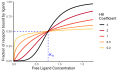 Hill-Langmuir equation
 -
 Plot of % saturation of O2 binding to haemoglobin as a function of O2 pressure
 -
 Hill Plot
 -
 Dose response antagonist


