Colony collapse disorder: Difference between revisions
CSV import Tags: mobile edit mobile web edit |
CSV import |
||
| Line 26: | Line 26: | ||
{{bee-stub}} | {{bee-stub}} | ||
{{agriculture-stub}} | {{agriculture-stub}} | ||
<gallery> | |||
File:Honeybee-cooling_cropped.jpg|Colony collapse disorder | |||
File:Inspecting_the_bees'_work.JPG|Colony collapse disorder | |||
File:US_honey_bee_hives_1982-2015.png|Colony collapse disorder | |||
File:Varroa_destructor_on_honeybee_host.jpg|Colony collapse disorder | |||
File:Parasite140019-fig4_Nosema_podocotyloidis_-_Hyperparasitic_Microsporidia.tif|Colony collapse disorder | |||
File:New_Holland_TL_90_and_field_sprayer_1.jpg|Colony collapse disorder | |||
File:Imidacloprid_USA_2012.png|Colony collapse disorder | |||
File:Bee_Collecting_Pollen_2004-08-14.jpg|Colony collapse disorder | |||
File:Pollinationn.jpg|Colony collapse disorder | |||
File:Bienenwabe_mit_Eiern_und_Brut_5.jpg|Colony collapse disorder | |||
File:Bee_migration_9045.JPG|Colony collapse disorder | |||
File:Drohnenpuppen_79d.jpg|Colony collapse disorder | |||
</gallery> | |||
Revision as of 12:19, 18 February 2025
Colony collapse disorder (CCD) is a phenomenon that occurs when the majority of worker bees in a colony disappear, leaving behind a queen, plenty of food, and a few nurse bees to care for the remaining immature bees. While such disappearances have occurred throughout the history of apiculture, the term colony collapse disorder was first applied to a drastic rise in the number of disappearances of Western honey bee colonies in North America in late 2006.
Causes
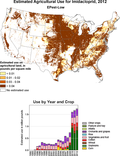
The exact cause of CCD is unclear, but many possible causes have been proposed, including infections, mites, environmental change-related stresses, malnutrition, and pesticides such as neonicotinoids. Other proposed causes include genetically modified crops with pest control characteristics, and electromagnetic radiation from cellular phones or other man-made devices.
Symptoms
The primary symptom of CCD is very low or no adult honey bees present in the hive but with a live queen and no dead honey bee bodies present. Often there is still honey in the hive, and immature bees (brood) are present.
Impact
CCD can significantly affect the beekeeping industry and also agriculture more broadly, as a large portion of agricultural crops worldwide are pollinated by bees.
Prevention and control
Prevention and control of CCD is complex due to the many possible causes. Strategies include improving the general health of bees, controlling mites and other pests, and reducing the use of pesticides.
See also


This article is a agriculture stub. You can help WikiMD by expanding it!
-
 Colony collapse disorder
 -
 Colony collapse disorder
 -
 Colony collapse disorder
 -
 Colony collapse disorder
 -
 Colony collapse disorder
 -
 Colony collapse disorder
 -
 Colony collapse disorder
 -
 Colony collapse disorder
 -
 Colony collapse disorder
 -
 Colony collapse disorder
 -
 Colony collapse disorder
 -
 Colony collapse disorder


