Pereskia aculeata: Difference between revisions
CSV import Tags: mobile edit mobile web edit |
CSV import |
||
| Line 41: | Line 41: | ||
[[Category:Medicinal plants]] | [[Category:Medicinal plants]] | ||
{{cactus-stub}} | {{cactus-stub}} | ||
<gallery> | |||
File:Pereskia_aculeata4_cropped.jpg|Pereskia aculeata | |||
File:Pereskia_aculeata_cut_stem_Ilanda.JPG|Cut stem of Pereskia aculeata | |||
File:Ein_Gedi_Botanical_Gardens037.jpg|Pereskia aculeata in Ein Gedi Botanical Gardens | |||
File:Pereskia_aculeata_old_stem_Ilanda.JPG|Old stem of Pereskia aculeata | |||
File:Pereskia_aculeata_fruit.jpg|Fruit of Pereskia aculeata | |||
</gallery> | |||
Latest revision as of 04:26, 18 February 2025
Pereskia aculeata, also known as Barbados gooseberry, Blade-Apple or Leaf Cactus, is a species of cactus that is native to tropical America. It is a climbing plant that can reach up to 10 meters in height and is known for its edible fruits and leaves.
Description[edit]
Pereskia aculeata is a climbing shrub with a woody stem. The leaves are large, glossy, and bright green, and the plant produces clusters of white or yellowish flowers. The fruits are yellow and resemble small gooseberries, hence the common name Barbados gooseberry. Unlike most cacti, Pereskia aculeata has leaves and is not succulent, which has led to its being described as a "primitive" cactus.
Distribution and habitat[edit]
Pereskia aculeata is native to tropical America, from Florida and the Caribbean south to Brazil. It is found in a variety of habitats, from coastal areas to mountainous regions. It is often found growing in disturbed areas and has been known to become invasive in some regions.
Uses[edit]
The leaves and fruits of Pereskia aculeata are edible and are used in traditional cooking in many parts of its native range. The leaves are high in vitamin C and protein, and the fruits are sweet and tangy. In addition to its culinary uses, Pereskia aculeata is also used in traditional medicine and is grown as an ornamental plant.
Cultivation[edit]
Pereskia aculeata is a hardy plant that can tolerate a range of conditions. It prefers full sun but can tolerate partial shade, and it is drought-tolerant once established. It can be propagated from seeds or cuttings.
Conservation status[edit]
While Pereskia aculeata is not currently considered to be at risk, habitat loss and overharvesting for food and medicine could potentially threaten this species in the future.
See also[edit]
References[edit]
External links[edit]

-
 Pereskia aculeata
 -
 Cut stem of Pereskia aculeata
 -
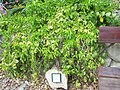 Pereskia aculeata in Ein Gedi Botanical Gardens
 -
 Old stem of Pereskia aculeata
 -
 Fruit of Pereskia aculeata


