Perivascular space: Difference between revisions
CSV import |
CSV import |
||
| Line 32: | Line 32: | ||
[[Category:Neuroanatomy]] | [[Category:Neuroanatomy]] | ||
{{anatomy-stub}} | {{anatomy-stub}} | ||
==Perivascular_space== | |||
<gallery> | |||
File:VirchowRobin.png|Virchow-Robin space illustration | |||
File:CT_of_dilated_Virchow-Robin_spaces.png|CT scan of dilated Virchow-Robin spaces | |||
File:T2W_MRI,_showing_unilateral_dilated_Virchow-Robin_Spaces.jpg|T2-weighted MRI showing unilateral dilated Virchow-Robin spaces | |||
File:CSF_circulation.png|Cerebrospinal fluid circulation | |||
</gallery> | |||
Latest revision as of 05:05, 18 February 2025
Perivascular space also known as Virchow-Robin spaces are fluid-filled cavities surrounding the blood vessels in the brain and spinal cord. They are part of the glymphatic system, which is involved in the clearance of waste products from the brain.
Anatomy[edit]
Perivascular spaces are located between the wall of the blood vessels and the surrounding brain tissue. They are lined by leptomeninges, which are thin layers of tissue that cover the brain and spinal cord. The spaces are filled with cerebrospinal fluid (CSF), which provides a pathway for the exchange of substances between the blood and the brain.
Function[edit]
The main function of the perivascular spaces is to facilitate the clearance of waste products from the brain. This is achieved through the flow of CSF, which carries waste products away from the brain and towards the venous system, where they are eventually removed from the body. This process is crucial for maintaining the health and function of the brain.
In addition to waste clearance, perivascular spaces also play a role in the immune response of the brain. They provide a pathway for immune cells to reach the brain in response to injury or infection.
Clinical significance[edit]
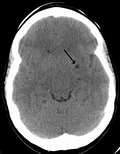
Abnormalities in the perivascular spaces can lead to a variety of neurological conditions. For example, enlargement of the perivascular spaces is associated with small vessel disease, which can cause stroke and dementia. Furthermore, blockage of the perivascular spaces can lead to the accumulation of waste products in the brain, contributing to the development of neurodegenerative diseases such as Alzheimer's disease and Parkinson's disease.
See also[edit]
- Glymphatic system
- Cerebrospinal fluid
- Leptomeninges
- Small vessel disease
- Alzheimer's disease
- Parkinson's disease
References[edit]

Perivascular_space[edit]
-
 Virchow-Robin space illustration
 -
CT scan of dilated Virchow-Robin spaces
-
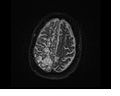 T2-weighted MRI showing unilateral dilated Virchow-Robin spaces
 -
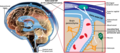 Cerebrospinal fluid circulation


