Orthodontic headgear: Difference between revisions
CSV import |
CSV import |
||
| Line 34: | Line 34: | ||
{{dentistry-stub}} | {{dentistry-stub}} | ||
==Orthodontic headgear== | |||
<gallery> | |||
File:Orthodontic_headgear.jpg|Orthodontic headgear | |||
File:Full_orthodontic_headgear_with_headcap_and_fitting_straps.jpg|Full orthodontic headgear with headcap and fitting straps | |||
File:Headgear_-_Reverse_Pull2.jpg|Reverse pull headgear | |||
File:ORTHODONTIC_FACE_MASK_REVERSE-PULL_HEADGEAR_TÜBINGER_MODEL.jpg|Orthodontic face mask reverse-pull headgear (Tübinger model) | |||
</gallery> | |||
Latest revision as of 04:58, 18 February 2025
Orthodontic headgear is a type of orthodontic appliance used in orthodontics, the branch of dentistry that corrects teeth and jaw irregularities. The purpose of orthodontic headgear is to correct the alignment of the teeth and jaw by applying force to the patient's teeth and jaw over time.
History[edit]
The use of orthodontic headgear dates back to the early 20th century. The first types of headgear were developed by Norman William Kingsley and Calvin Suverill Case, two pioneers in the field of orthodontics.
Types[edit]
There are several types of orthodontic headgear, each designed to correct different types of dental problems. The most common types include the cervical pull, high pull, and reverse pull headgear.
Cervical Pull[edit]
The cervical pull headgear is used to correct overbites by pulling the upper jaw back.
High Pull[edit]
The high pull headgear is used to correct overbites and also helps to control vertical growth in patients with long faces.
Reverse Pull[edit]
The reverse pull headgear, also known as a facemask, is used to correct underbites by pulling the upper jaw forward.
Usage[edit]
Orthodontic headgear is typically worn for 12 to 22 hours a day and must be worn consistently to achieve the desired results. The length of time a patient needs to wear headgear varies, but it is usually between 1 to 2 years.
Risks and Complications[edit]
While orthodontic headgear is generally safe, there are some risks and complications associated with its use. These can include discomfort, tooth decay, and root resorption. It is important for patients to maintain good oral hygiene and to follow their orthodontist's instructions to minimize these risks.
See Also[edit]

Orthodontic headgear[edit]
-
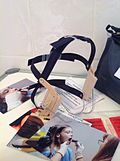 Orthodontic headgear
 -
 Full orthodontic headgear with headcap and fitting straps
 -
 Reverse pull headgear
 -
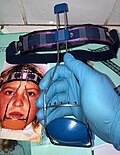 Orthodontic face mask reverse-pull headgear (Tübinger model)


