Kola nut: Difference between revisions
CSV import |
CSV import |
||
| Line 37: | Line 37: | ||
{{food-stub}} | {{food-stub}} | ||
{{Africa-stub}} | {{Africa-stub}} | ||
<gallery> | |||
File:Kolanut.jpg|Kola nut | |||
File:Cola_acuminata_-_Köhler–s_Medizinal-Pflanzen-183.jpg|Cola acuminata illustration | |||
File:Koeh-190.jpg|Botanical illustration of Cola | |||
File:Cola_MS_6687.JPG|Cola MS 6687 | |||
File:Coca-Cola_Advertisement.jpg|Coca-Cola Advertisement | |||
File:Cola-Acuminata-Heckel.jpg|Cola Acuminata by Heckel | |||
File:Theobroma_cacao_-_fruit,_from_inside,_beans.jpg|Theobroma cacao fruit and beans | |||
</gallery> | |||
Latest revision as of 11:12, 18 February 2025
Kola Nut
The Kola Nut is the fruit of the Kola tree, a genus of trees that are native to the tropical rainforests of Africa. The caffeine-containing fruit of the tree is used as a flavoring ingredient in beverages, and is the origin of the term "cola".
Description[edit]
The Kola tree is a genus of about 125 species of trees. They are native to the tropical rainforests of Africa, and commonly referred to as kola tree. The trees, which reach heights of 40 to 60 feet, produce a star-shaped fruit. Each fruit contains between two and five kola nuts.
Uses[edit]
The Kola Nut is often used in traditional ceremonies in certain African cultures. In addition to its cultural significance, the kola nut is also used for its stimulant properties. It contains caffeine, as well as two other stimulants, theobromine and kolanin.
The kola nut is also used in modern culture. It is a flavoring ingredient in certain types of cola soft drinks. In addition to its use in drinks, the kola nut is also used in the production of certain types of foods.
Health Effects[edit]
The Kola Nut has a number of potential health effects. Its high caffeine content can lead to a rapid heart rate and increased blood pressure. In addition, it can cause insomnia, nervousness, and restlessness. However, it is also used in traditional medicine for its stimulant effects, and it is thought to aid digestion and improve concentration.
Cultivation[edit]
The cultivation of the Kola Nut is most common in certain countries in West Africa, including Ivory Coast, Nigeria, and Ghana. The trees prefer a tropical climate and lots of rainfall, so they are best suited to the rainforest environment.
See Also[edit]
References[edit]
<references />


-
 Kola nut
 -
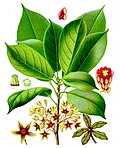 Cola acuminata illustration
 -
 Botanical illustration of Cola
 -
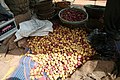 Cola MS 6687
 -
 Coca-Cola Advertisement
 -
 Cola Acuminata by Heckel
 -
 Theobroma cacao fruit and beans


