Hibiscus syriacus: Difference between revisions
CSV import |
CSV import |
||
| Line 19: | Line 19: | ||
[[Category:Medicinal plants]] | [[Category:Medicinal plants]] | ||
{{plant-stub}} | {{plant-stub}} | ||
<gallery> | |||
File:Hibiscus_syriacus_(12).JPG|Hibiscus syriacus | |||
File:Migrant_hawker_(Aeshna_mixta)_male_on_rose_mallow_(Hibiscus_syriacus).jpg|Migrant hawker on Hibiscus syriacus | |||
File:Hibiscus_August_2010-2.jpg|Hibiscus syriacus | |||
File:Hibiscus_Lavender_Chiffon.jpg|Hibiscus syriacus 'Lavender Chiffon' | |||
File:Flag_of_the_President_of_South_Korea.svg|Flag of the President of South Korea | |||
File:20200705122409_ed1.jpg|Hibiscus syriacus | |||
</gallery> | |||
Latest revision as of 11:06, 18 February 2025
Hibiscus esculentus, also known as okra or lady's finger, is a flowering plant in the mallow family. It is valued for its edible green seed pods. The plant is cultivated in tropical, subtropical and warm temperate regions around the world.
Description[edit]
Hibiscus esculentus is an annual herb that can grow up to 2 meters tall. The plant's leaves are 10–20 cm long and broad, palmately lobed with 5–7 lobes. The flowers are 4–8 cm in diameter, with five white to yellow petals, often with a red or purple spot at the base of each petal. The fruit is a capsule up to 18 cm long, containing numerous seeds.
Cultivation[edit]
Hibiscus esculentus is a popular vegetable in many parts of the world. The plant is cultivated for its fibrous fruits or pods, which are used in cooking. The pods are picked when immature and are typically used in stews and soups. The seeds are also used as a source of oil.
Uses[edit]
In addition to its use as a vegetable, Hibiscus esculentus has several other uses. The leaves and flowers can be used to make a herbal tea, and the seeds can be roasted and ground into a coffee substitute. The plant is also used in traditional medicine, particularly in Africa, for the treatment of various ailments.
See also[edit]

-
 Hibiscus syriacus
 -
 Migrant hawker on Hibiscus syriacus
 -
 Hibiscus syriacus
 -
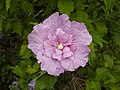 Hibiscus syriacus 'Lavender Chiffon'
 -
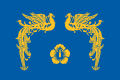 Flag of the President of South Korea
 -
 Hibiscus syriacus
.JPG)
_male_on_rose_mallow_(Hibiscus_syriacus).jpg)


