Baccharis halimifolia: Difference between revisions
CSV import |
CSV import |
||
| Line 24: | Line 24: | ||
[[Category:Asteraceae]] | [[Category:Asteraceae]] | ||
{{Asteraceae-stub}} | {{Asteraceae-stub}} | ||
== Baccharis halimifolia gallery == | |||
<gallery> | |||
File:Baccharis halimifolia.jpg|Baccharis halimifolia | |||
File:Baccharis halimifolia range map 1.png|Baccharis halimifolia range map | |||
File:baccharis halimifolia bush.jpg|Baccharis halimifolia bush | |||
File:Groundseltree Baccharis halimifolia fall pappus close.jpg|Groundseltree Baccharis halimifolia fall pappus close | |||
File:Carl von Linné.jpg|Carl von Linné | |||
File:Groundseltree Baccharis halimifolia seedheads leaves.jpg|Groundseltree Baccharis halimifolia seedheads leaves | |||
</gallery> | |||
Latest revision as of 05:22, 3 March 2025
Baccharis halimifolia, also known as groundsel tree, salt bush, or sea myrtle, is a North American species of shrubs in the aster family. It is native to coastal areas of the eastern and southern United States, as well as parts of Mexico and the Caribbean.
Description[edit]
Baccharis halimifolia is a deciduous shrub that typically grows to a height of 1–4 meters. The leaves are alternate, simple, and 2–7 cm long. The upper surface of the leaves is dark green and the lower surface is white with dense, woolly hairs. The flowers are small, white, and appear in dense clusters. The fruit is a small achene.
Distribution and habitat[edit]
Baccharis halimifolia is found in coastal areas from Massachusetts south to Florida and west to Texas in the United States. It also occurs in parts of Mexico and the Caribbean. The species is typically found in salt marshes, dunes, and coastal prairies.
Ecology[edit]
Baccharis halimifolia is a pioneer species, often colonizing disturbed areas. It is tolerant of salt and can grow in saline conditions, making it an important species in coastal ecosystems. The plant provides habitat and food for a variety of wildlife, including birds and insects.
Uses[edit]
Historically, Baccharis halimifolia has been used in traditional medicine. The leaves have been used to treat rheumatism and kidney problems. The plant has also been used as a windbreak and for erosion control in coastal areas.
Conservation[edit]
While Baccharis halimifolia is not currently considered threatened, it is vulnerable to habitat loss due to coastal development and sea level rise.
References[edit]
<references />

This article is a Asteraceae-related stub. You can help WikiMD by expanding it!
Baccharis halimifolia gallery[edit]
-
 Baccharis halimifolia
 -
 Baccharis halimifolia range map
 -
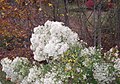 Baccharis halimifolia bush
 -
 Groundseltree Baccharis halimifolia fall pappus close
 -
 Carl von Linné
 -
 Groundseltree Baccharis halimifolia seedheads leaves


